
The Beginning of the Dilution of the Wounded Primrose: A Love-Hate Reflection
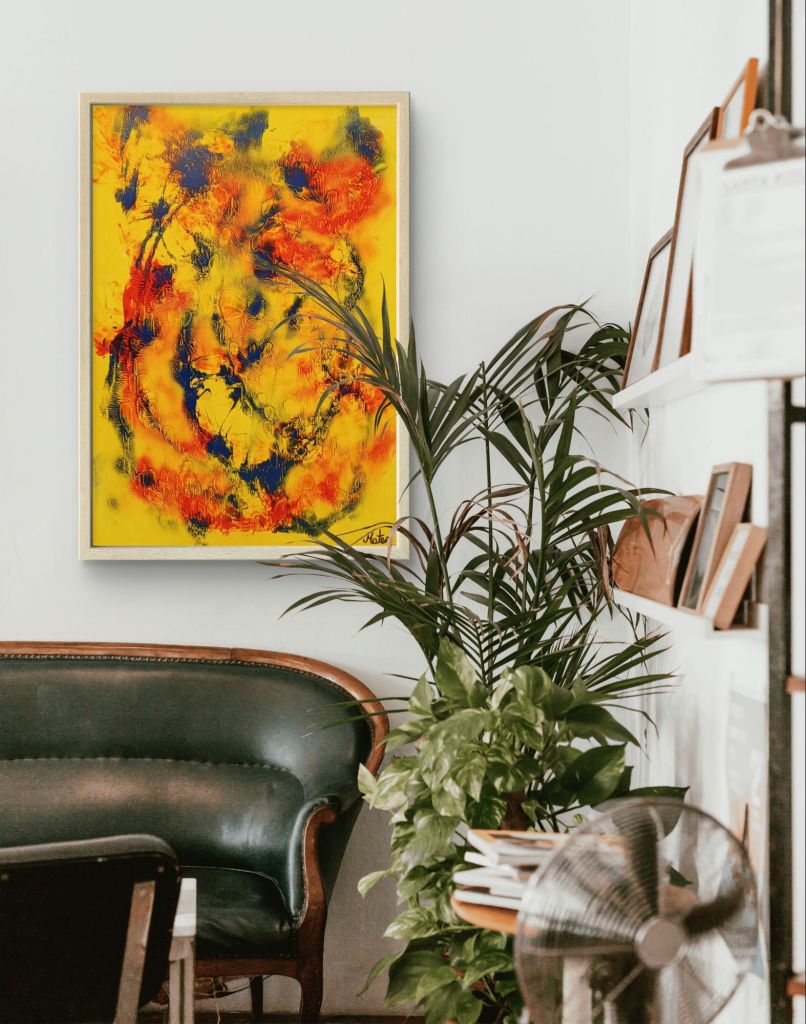
There are paintings you admire, paintings you study, and paintings that stay in the room even when you leave. The Beginning of the Dilution of the Wounded Primrose by Matea Balaban, known as Rain Bordo, falls into the last category. It doesn’t whisper, it doesn’t wait. It demands. With its feverish yellow and its violent swirls of red and blue, this piece is a raw nerve, and I’ve spent too long poking it.
I want to say I love it. I also want to say it makes me sick. The truth sits somewhere between awe and aversion. It’s the visual equivalent of holding your breath in a room that’s too warm, too loud, too full of someone else’s history — but you can’t look away. And maybe that’s the point.
I. Color as Collision
Let’s start with the obvious: the color. The dominant yellow in this painting is not sunshine. It’s not joy. It’s chemical — the kind of yellow that hums under your skin, that warns rather than welcomes. It feels radioactive. Toxic. Like a primrose blooming on the edge of a hazard zone.
Then come the reds. Not delicate, not floral. These are red like infection, like bruised tissue, like something inside the body exposed to daylight. Red that doesn’t bleed so much as it bursts. It fights with the yellow — no harmony, no blend. And weaving through it all is a deep, dense blue, like veins or ink or something trying to anchor the chaos.
The colors aren’t working together. They’re competing. And that friction is what draws me in. It reminds me of how beauty and discomfort often share the same space. How something can be captivating and repulsive in the same breath. This is not a palette of ease. This is confrontation.
II. The Wound and the Primrose
The title — The Beginning of the Dilution of the Wounded Primrose — sets the tone before your eyes even meet the canvas. It’s almost poetic, but not soft. It speaks of damage. Of something once intact now in the process of being thinned, faded, maybe healed — or maybe erased. That ambiguity is what holds me hostage.
A primrose is a fragile thing. A spring flower. The kind of thing people usually photograph with sunlight behind it, trying to capture purity. But here, the primrose is wounded. Already harmed. Already stained. And the “dilution” doesn’t promise rescue. It could mean the pain is being eased. Or that its identity is being washed away.
I keep circling that word: dilution. It suggests a process. It’s not the moment of trauma, not the cut. It’s what comes after. It’s the slow spreading of whatever came next — sorrow, numbness, confusion. The painting doesn’t show a flower. It shows what happens after the flower has been touched by something uninvited. And I think that’s where my discomfort stems from. It’s like I’m looking at a scar that hasn’t decided if it wants to be remembered or hidden.
The wound is not the center. The process is. And that, I think, is where the genius sits
III. Texture and Violence
There’s a physicality to the painting that makes me want to touch it — and not gently. The textures look like they’ve been scratched in, clawed maybe. It’s not polite. It’s not careful. It feels like someone was trying to rip something out of themselves and shove it into pigment.
I don’t know what medium Rain Bordo used here — acrylic, oil, maybe even mixed media — but whatever it is, it feels aggressive. Not just expressive. Aggressive. There’s a violence in how the layers interact, like the colors are trying to dominate each other. And no one’s winning.
This kind of emotional violence is rare in visual art, at least in a way that feels this raw and personal. Most artists filter. They frame their pain with structure, composition, logic. But this piece throws logic aside. It bleeds. And yet, it’s not messy. It’s composed chaos. Like a breakdown staged for the camera, but the emotion underneath is still real.
And I hate how much I relate to that.
This painting doesn’t have a center, at least not a calm one. The eye keeps getting pulled into loops — circular motions of red and blue that refuse to settle. It feels like falling into your own mind when it’s spiraling: no anchor, no exit. The composition mimics psychological disorientation. Not the textbook kind, the real kind. The kind you feel at 3 a.m. when your thoughts are screaming over each other.
It’s a map of the anxious mind.
The more I look at it, the more it becomes a portrait of panic. There’s a suffocating tightness to the layout — everything crammed inward, each stroke choking the next. But it’s not total chaos. There’s a rhythm. A pattern. Like the brain trying to create order in the middle of collapse.
And that’s what gets me. Because I know that rhythm. I’ve lived it. That obsessive need to make something beautiful out of a breakdown. That furious urge to externalize pain so it stops rotting inside you.
This painting doesn’t soothe me. It mirrors me. And I don’t know if I’m grateful for that or resent it. Maybe both.
Let’s talk about the love first.
I love this piece because it’s honest. Brutally so. It doesn’t try to please. It doesn’t flatter the viewer. It dares you to sit with discomfort. It makes no attempt at elegance — and yet somehow, in its distortion, it achieves something close to grace. Not beauty, exactly. But truth. And sometimes truth is uglier than we’d like it to be.
I love how it doesn’t wait for interpretation. It confronts. It yells. It refuses to be neutral. And I admire that. Because too much of art now is afraid of being too much. It wants to be liked. This painting doesn’t give a damn.
I love how it lingers. How I’ve gone days without seeing it and still felt it pressing against the back of my mind. How it’s become a part of my mental furniture, whether I invited it in or not.
I love how it reminds me that healing is not linear. That dilution isn’t always about disappearing — sometimes it’s just about learning how to carry the wound without letting it bleed all over everything you touch.
But then, the hate.
I hate how this painting makes me feel exposed. Like it knows me. Like it’s holding up a mirror and forcing me to look when I’d rather keep my gaze elsewhere. There’s no escape in this work. No soft edges. No place to rest.
I hate how it clings. It feels invasive. Like an echo I didn’t consent to.
I hate the yellow. I hate how it makes the room feel hotter. Like it’s raising the temperature on purpose just to see if you’ll sweat.
I hate that it doesn’t end. There’s no resolution in this piece. No final stroke, no “ah, there it is.” It’s open-ended. Infinite. Like trauma. Like memory. Like grief you’ve learned to live with because it never really leaves.
I hate that I keep coming back to it. That no matter how much it unsettles me, I still need to look at it. Like I’m trying to understand something about myself through its chaos. Like it holds an answer I don’t want, but can’t stop searching for.
Absolutely. I’ll build toward a closing that brings empathy into focus — not just toward the painting, but toward ourselves as viewers, carriers of wounds, survivors of intensity. Here’s the final stretch:
In a world oversaturated with curated images, polite filters, and controlled narratives, The Beginning of the Dilution of the Wounded Primrose is an act of rebellion. It’s not aesthetic in the Instagram sense. It doesn’t match your couch. It doesn’t care about calming you down. It doesn’t heal you — it reminds you that healing is work, and that work is often ugly, repetitive, and invisible.
Rain Bordo paints like someone who isn’t afraid to make the viewer uncomfortable. That’s rare. The art world too often rewards restraint over rawness, clarity over conflict. But this piece? It leans into rupture. It doesn’t flatten emotional complexity into something digestible. It lets it stay jagged.
And maybe that’s why it feels modern, even timeless. Because what it shows us isn’t bound by a trend — it’s bound by the shared human experience of surviving yourself.
In this way, the painting isn’t just about the artist. It’s about all of us. Our wounds. Our attempts at dilution. Our messy, unfinished healing processes. And the fact that art can hold space for that — not clean it up, but hold it — is deeply human.
So here it is: the part I resisted writing, the part I finally understand.
This painting is an act of empathy.
It doesn’t coddle. It doesn’t comfort. But it sees. It reflects the internal storm without trying to fix it. It doesn’t suggest that the primrose will bloom again, or that the wound will close. It simply says: I know this. I’ve been here too. Look.
And that matters.
In a world that so often demands performance — of wellness, of stability, of strength — this painting says it’s okay to still be diluted. To still be wounded. To still be becoming.
That’s why I come back to it. That’s why I love it, even as I hate what it makes me feel. Because it reminds me that complexity isn’t failure. That the things I carry — the griefs, the fractures, the heat, the noise — don’t disqualify me from beauty or meaning. They are the meaning.
The painting doesn’t solve me. It doesn’t explain me. But it meets me where I am. It doesn’t clean the blood off the flower. It shows me how it still stands, even soaked.
And that — in all its chaotic, painful, vibrant mess — is empathy.
 Rain Bordo