
Title: Sunset Ballerina
Artist: Mateo Balaban aka Rain Bordo
Medium: Acrylic on canvas
Style: Abstract Expressionism with lyrical abstraction
Theme: Empathy, inner light, transition
✦ Visual Composition & Technique
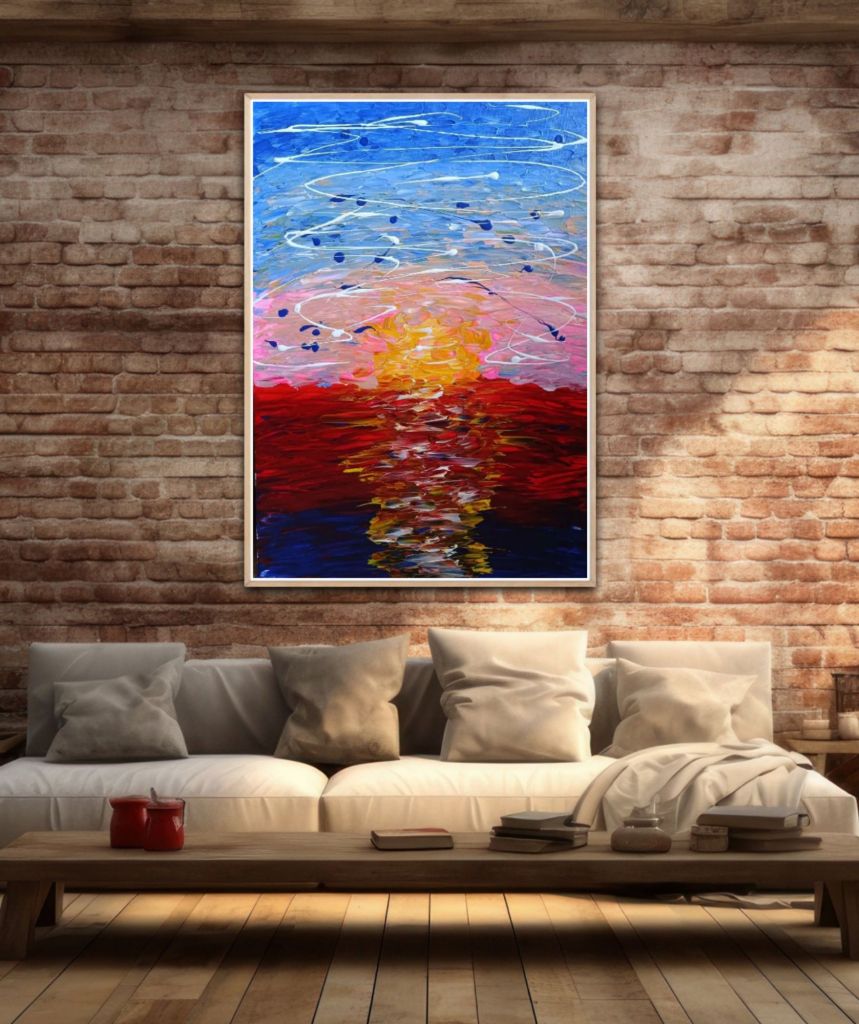
Mateo Balaban’s painting confronts us with a vertical canvas that pulsates with warmth and emotional ambiguity. The first immediate observation is the division of the work into horizontal bands of color: a celestial blue top, a fiery red center, and a deep, reflective lower half—blended together by the radiance of a sun descending or rising at the heart of the piece.
The brushstrokes are bold, layered, and emotive, yet restrained enough to preserve structure amidst abstraction. The upper portion, painted with cerulean blues and strokes of white and navy, resembles a sky scattered with swirling winds or floating thoughts. These circular gestures of paint, both chaotic and orchestrated, suggest movement of something ungraspable—like memory or breath.
The middle band explodes in a crescendo of reds and pinks, and from that center emerges the yellow-orange sun, whose reflection pierces downward like a wound into the darker depths below. The lower area, painted with streaks of blue, black, and yellow, functions like a mirror to the upper world, but fractured, less perfect—more human.
✦ Emotional and Conceptual Reading
At the center of Balaban’s abstract landscape is empathy—not as a decorative idea, but as an embodied force. The painting doesn’t depict empathy; it enacts it. The way the sky folds into the sea, how warmth spills into shadow, and how movement is traced across stillness—all mirror the way human emotions bleed into one another.
Empathy here is not a simple kindness; it’s a reckoning with contrast: warmth versus coldness, light versus obscurity, serenity versus turbulence. The sun becomes a metaphor for human connection—radiant, vulnerable, temporary. Its reflection isn’t a perfect replica, but a distorted echo, reminding us that what we offer emotionally to others may be altered in translation—but it still matters.
The swirling marks above the horizon, reminiscent of wind or dance, echo the inner chatter of empathy—the tension between understanding and misreading, between reaching out and withdrawing. They also suggest synaptic connections, as if the canvas itself were a brain, trying to make sense of otherness.
✦ Material Empathy
Balaban’s texture is significant. The thick layering of paint, particularly in the reds and yellows, speaks of emotional labor—a physical effort to build meaning and presence. His use of palette knife or thick brush gives the painting a tactile empathy—you don’t just see this painting, you feel it. The texture suggests that emotion is not smooth or easily digested. It has friction.
✦ The Space It Occupies
Displayed against a raw brick wall, above a minimalist sofa, the painting becomes more than art—it becomes a presence. In such a setting, it evokes the contrast between inner warmth and external roughness—an empathetic body in a brutal world. The environment completes the emotional narrative: human softness trying to live with unresolved edges.
✦ Empathy and Rain Bordo’s Aesthetic Philosophy
Rain Bordo is known for refusing stylistic confinement. His work floats between poetry and pigment, between chaos and grace. In this painting, the refusal to define the light as purely sunrise or sunset mirrors his refusal to define emotion with finality. Like empathy, his work remains in-between, fluid, unsettled.
Empathy, in Balaban’s universe, is not sentimental. It is an act of recognition: of someone else’s weather, someone else’s color, someone else’s pain. This canvas is a sunset of the soul, radiant but unresolved, inviting viewers to sit in discomfort and light at once.
✦ Final Thought
This painting is not asking you to look—it is asking you to listen with your eyes. To stand before it is to be offered a silent invitation: reflect not on the sun, but on your reflection in its warmth. What part of your own empathy burns quietly? Where is your own horizon bleeding?
In Rain Bordo’s work, empathy is never still. It is always becoming—light trying to understand itself in the arms of darkness.
 Rain Bordo