First love of Vincent van Gogh
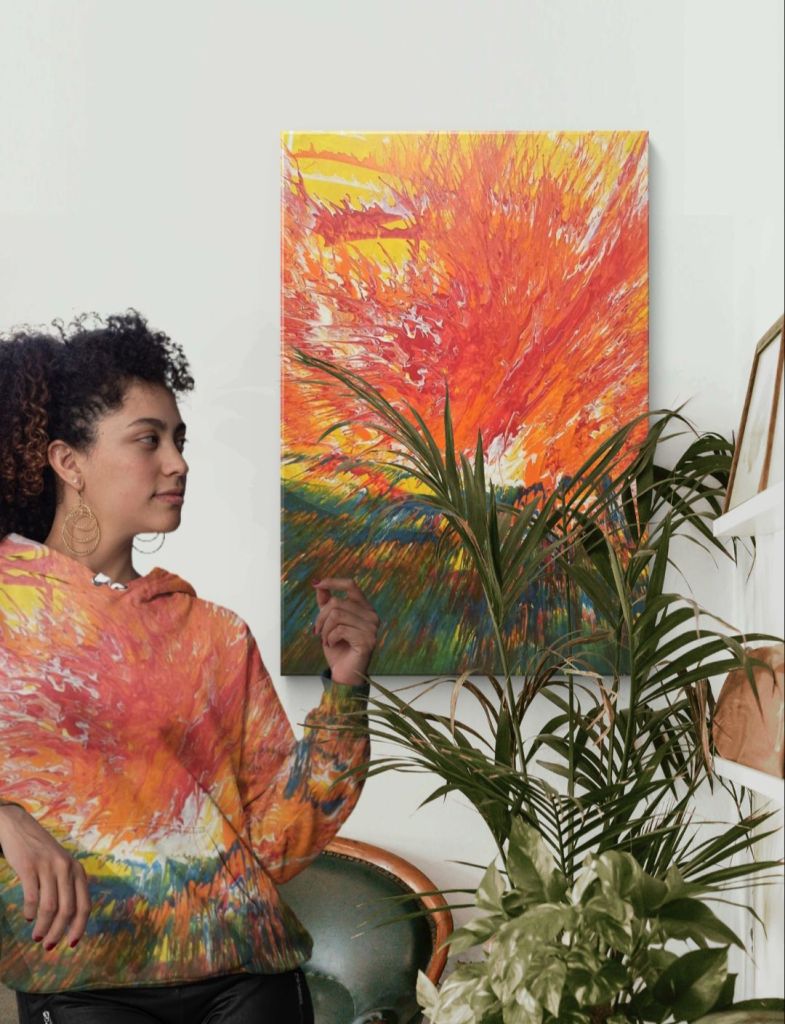
The painting in question, created by Croatian artist Mateo Balaban, known as Rain Bordo, is a powerful visual symphony that erupts in a vibrant fusion of color and motion. The composition feels as though fire and wind have collided with a field of wild emotions—where orange, red, and yellow tones burst like solar flares above a more grounded, darker green and blue undercurrent. There is no literal subject; instead, we are confronted with an abstract force—energy in its purest, untamed form. The painting radiates like a storm of emotions, or perhaps even a sunrise tearing apart the calm with raw intensity. The brushwork is kinetic, unrestrained, and expressive, with visible directional flow that draws the viewer into a vortex of passionate movement.
What makes this piece truly fascinating is its transformation into fashion—a hoodie that becomes not just clothing but a wearable artwork. The shift from canvas to textile adds a layer of interaction: the viewer becomes the wearer; the art, no longer confined to a frame, enters public space. The woman wearing the hoodie does not merely wear a design—she becomes part of the painting’s energy. The fabric hugs the explosion of color, folding it across a moving human body. This metamorphosis is not just stylistic but conceptual: the painting’s emotion now travels, breathes, and interacts with the world in new and unpredictable ways.
The fashion piece captures the central core of the painting—its radiant burst—and distributes it fluidly across a surface meant to move. It proves that abstract expressionism is not bound to static surfaces; it can pulse through fabric, it can walk the streets. Moreover, the dialogue between the stillness of the framed canvas and the life within the hoodie elevates both objects. One is a contemplative storm, the other is a storm in motion.
Rain Bordo achieves something rare here: a cross-pollination between fine art and contemporary fashion without compromising the emotional gravity of either. It is not merchandise—it is migration. Art migrates from wall to body, from gallery to street, from solitude to shared gaze.
In a world oversaturated with fast visuals, this pairing demands a second look—and perhaps a longer pause. It is a wearable painting, yes, but more than that: it is a statement that feeling, when expressed honestly, can transcend medium and still retain its full force.
 Rain Bordo