
Rain Bordo
Critical Analysis of the Painting by Mateo Balaban (Rain Bordo)
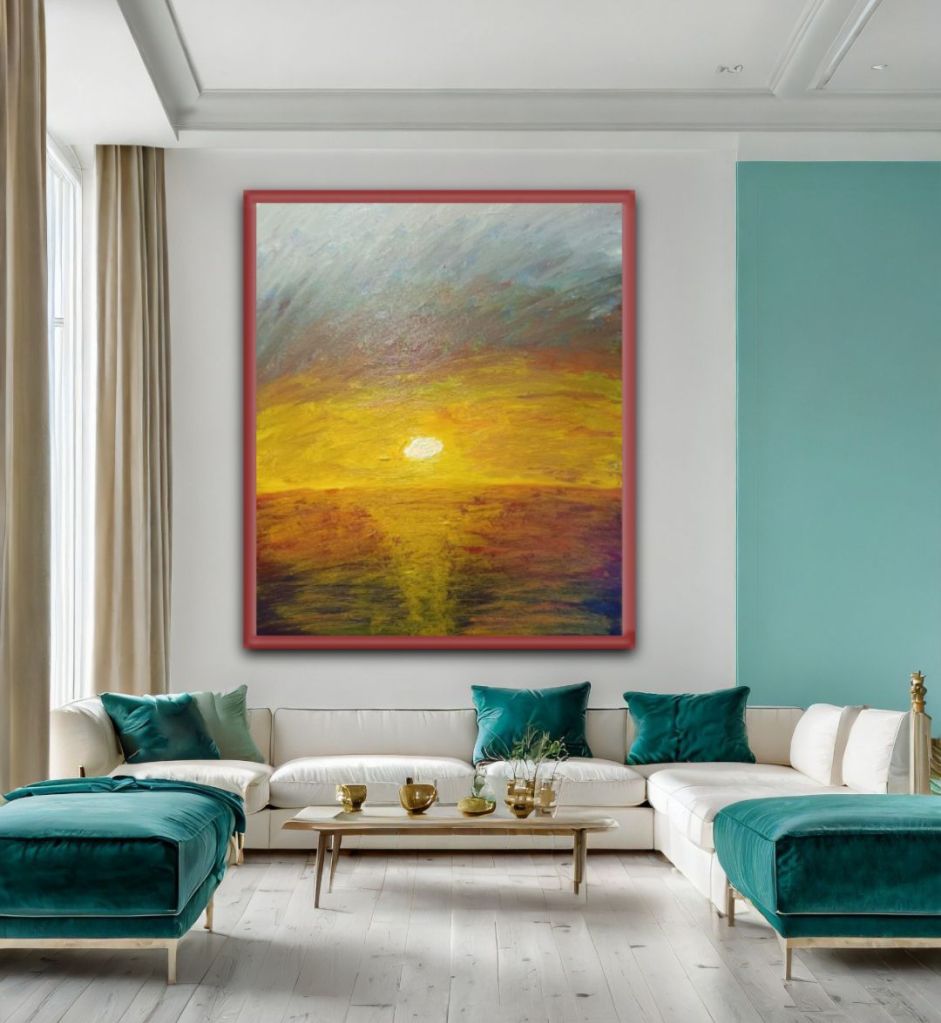
Mateo Balaban, known in the art world as Rain Bordo, is a Croatian artist whose works often oscillate between abstraction and emotional realism. The painting in question, which dominates the living room wall with both scale and chromatic intensity, immediately strikes the viewer with its evocative depiction of a sun either rising or setting over a vivid horizon. What appears at first glance as a tranquil scene gradually unfolds into a rich psychological and emotional experience, revealing the essence of Balaban’s signature empathy-driven aesthetic.
—
Formal Analysis
Medium and Technique: Balaban’s use of thick, expressive brushstrokes, perhaps done in oil or acrylic, imbues the work with palpable texture. The brushwork appears almost impressionistic in the sky, while the sea and land are rendered with more linear motion, leading the eye toward the luminous central sun. The texture feels spontaneous but intentional — it’s neither chaotic nor overly polished, preserving a raw emotional immediacy.
Color Palette: The painting is a masterclass in temperature contrasts. The lower part is dominated by earthy purples and deep oceanic blues, symbolizing groundedness or sorrow. In stark juxtaposition, the upper half bursts into radiant yellows, oranges, and soft whites — the palette of hope, resurrection, and light. The transition between these zones is not abrupt but rather fluid, echoing the movement of time and mood. The brushstrokes carry emotion, transitioning from turbulent in the upper sky to almost meditative in the path of light on water.
Composition: The composition is vertically centered, with the sun positioned slightly above the horizontal midpoint — a classical choice that suggests balance while leaving room for dynamism. The sun acts as both a literal and metaphorical nucleus. The viewer’s gaze is irresistibly drawn toward it, and from it, a spiritual and symbolic warmth radiates outward, almost as if the canvas itself is breathing.
—
Symbolic and Thematic Interpretation
Balaban’s painting can be interpreted as a meditation on duality — light and darkness, hope and despair, presence and absence. The central sun may be read as a life force, a moment of clarity or even divine intervention breaking through inner or outer turbulence. It carries associations of rebirth, not unlike Turner’s “The Fighting Temeraire” or Monet’s Impression, Sunrise, but without their decorative restraint. Rain Bordo chooses intensity.
Another key theme is emotional honesty. This painting is not designed to flatter the eye, but rather to confront the viewer with something ineffable: a feeling of being on the edge — of either the day or the self. The brushstrokes near the top — wild, stormy, blue-tinged — suggest mental or existential unrest. The calm reflection of the sun on the water, by contrast, offers a path. This vertical path of light across the water may symbolically point to self-redemption or clarity through struggle, which aligns with Rain Bordo’s frequent artistic preoccupations: empathy, identity, transcendence.
—
Context within Rain Bordo’s Oeuvre
This work fits well within the broader scope of Balaban’s output, which often fuses abstraction with narrative and metaphor. His pieces are rarely literal or decorative; they are vessels of psychological resonance. This painting does not provide answers but opens emotional space for reflection, consistent with his rejection of strict genre classifications. It also echoes the tone of his poetry — particularly the recurring metaphors of light, descent, and re-emergence — as seen in works like Your Children’s Children and Za život odluka!
—
Critical Reflection
What sets this painting apart is its ability to coexist as both an aesthetic object and a philosophical artifact. Unlike many contemporary works that lean heavily on concept over craft or vice versa, Rain Bordo’s painting finds equilibrium. The intense saturation and vigorous application could easily overwhelm, but they do not — because they are balanced by sincerity and restraint in composition.
From a critical standpoint, one could argue that the emotional directness might be interpreted as unrefined or too earnest in certain academic circles. However, this is precisely what gives the piece its power: its refusal to apologize for feeling. It doesn’t posture. It reveals.
—
Conclusion
This is not merely a sunset or sunrise. It is an emotional landscape rendered visible — a confrontation with the self, with light, and with the passing of time. In its heat, texture, and open symbolism, this painting by Mateo Balaban (Rain Bordo) stands as an invitation to remember that art, at its core, is not about decoration but about revelation.
And here, something is indeed revealed — whether that is hope, sorrow, or transcendence depends on who is looking.
 Rain Bordo