“The Little Dot of Hope That Still Exists”
A Critical Review of unknown description of falling texture by Rain Bordo (Mateo Balaban)
There are moments when art stops being a silent mirror and becomes a pulsating voice in the room.
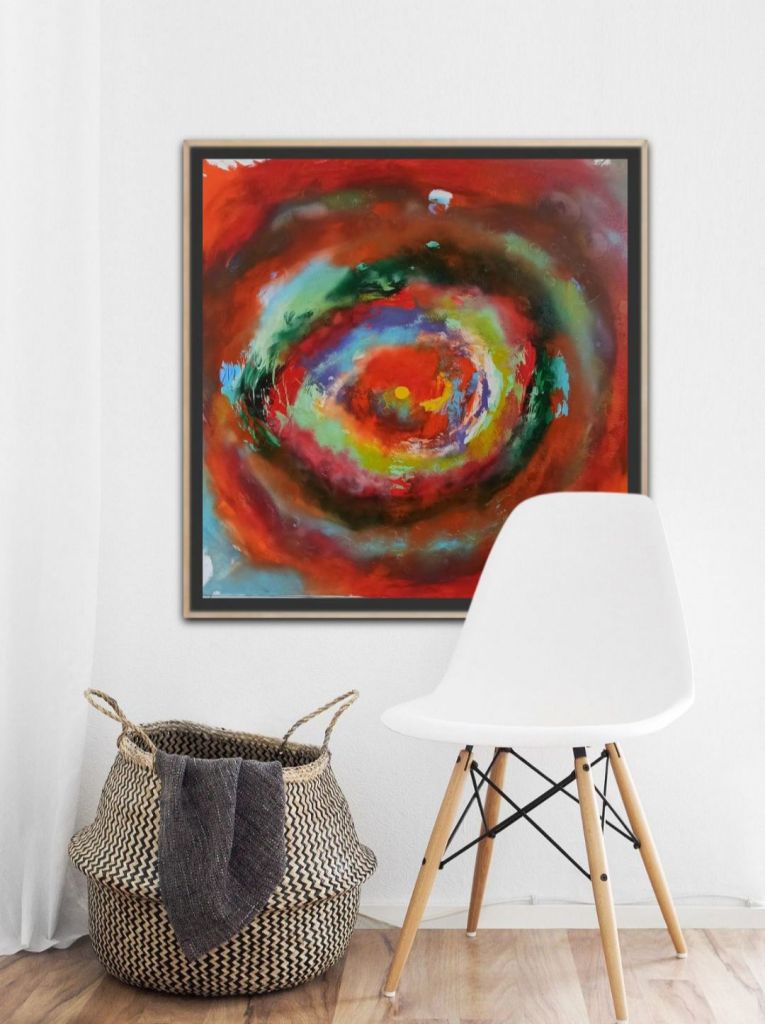
Mateo Balaban, under his evocative alter ego Rain Bordo, does precisely that with his hypnotic piece titled unknown description of falling texture. Yet, despite the abstract ambiguity suggested by its official title, the public has christened it with a more human, more aching name — “The Little Dot of Hope That Still Exists.” This duality alone introduces the emotional paradox Balaban orchestrates: between chaos and calm, between despair and persistence, between collapse and survival. ✨
At first glance, the canvas is a vortex — a spiral born of fire and mist, pulling the viewer into its center. One might mistake this as a rendering of a supernova, a galactic wound, or even the uncontainable birth of a new universe. The outer layers are soaked in deep crimson, bleeding into rust and muddy browns. As the eye spirals inward, it catches unexpected bursts of aqua, viridian, cobalt blue, and electric purple — until it finds the heart of the storm: a small, impossibly warm yellow dot.
The Texture of Emotion
From a purely painterly standpoint, Rain Bordo demonstrates mastery over textural dissonance. The canvas is not smooth — it’s visceral. The strokes are unapologetic, raw, and alive with kinetic energy. One can almost hear the brush gnashing against the surface, as though the painter was not painting but clawing through color to reach meaning. It’s as if the act of creation was both an exorcism and a confession.
In Balaban’s hands, color is not decoration — it’s psychology. The red is not simply red. It is rage, bleeding wounds, burning skies. The green isn’t just chlorophyll — it’s a memory of peace long forgotten. And that yellow? That singular, lonely, determined dot? It is the silent scream of a child who refuses to be swallowed by night.
There is motion in this piece. Not illusionary motion, but existential movement — the collapse of form, the explosion of self, the descent into the unknown. Yet, that descent is not entirely a fall. It’s also a search.
易 Abstract Narrative: Between Void and Meaning
Abstraction in contemporary painting often runs the risk of vanity or intellectual distance, but unknown description of falling texture is neither cold nor aloof. It is human, even when it is cosmic. The swirling energy within it reads as a narrative of mental collapse — depression, trauma, grief — but also, more importantly, of resilience.
The image could easily represent the crumbling psyche of someone spiraling into the darkest corners of their being. But amid the darkness, the painting dares to insert that yellow. That absurd little beacon. That warm, ridiculous act of hope. Like a whisper after an explosion. ️️
Balaban seems to be asking us:
“What happens if everything falls apart… but one small part doesn’t?”
That dot isn’t louder than the chaos. But it is more enduring. And in that act of endurance, it becomes a metaphor for everything that art should be. It becomes the soul.
The Emotional Anatomy of the Work
This painting hurts. But it also heals. It’s like the visual version of someone sobbing into a journal, unsure if the ink is made of words or tears.
One cannot look at this work without feeling. And not in a clichéd way — not in the “oh, it’s beautiful” sense. But in the sense of being cracked open. The viewer becomes vulnerable. Your eyes don’t just see the spiral — they become the spiral. You begin to trace your own wounds in the cyclone. You remember your own falling textures. Your own fading strength. And suddenly… that yellow becomes yours. ☀️
There’s an empathy here. And not the soft, sugary kind. This is empathy born of pain — the kind that can only emerge from someone who has endured collapse, but chose to tell the story anyway. That yellow dot isn’t just painted. It’s survived.
里 The Hidden Spiritual Layer
There is a quietly spiritual dimension within this work. Balaban, knowingly or unknowingly, channels ancient symbols: the spiral (representing growth, cycles, eternity), the dot (representing soul or essence in many Eastern traditions), and the concentric movement (a journey inward, as in meditation or introspection).
Seen through this lens, unknown description of falling texture becomes a kind of abstract mandala — not one meant to be worshiped, but one to be felt. It’s as if the painting doesn’t demand belief; it demands presence. 律
What if the canvas is not falling at all? What if it’s transforming?
留 The Viewer as Participant
Rain Bordo never simply shows. He invites. And in this work, the viewer is not just an observer — they are a participant. They are asked to fall into the spiral, to confront their own fears, to identify their own yellow dots.
And therein lies the power of this work: its universality. It doesn’t speak only to art collectors or critics. It speaks to everyone who has ever almost given up, but didn’t. 輸
The painting feels almost like a friend. A friend who doesn’t cheer you up, but sits with you in the storm and quietly reminds you that you’re still here.
The Public Renaming: A Cultural Gesture
It is telling — and beautiful — that the public has unofficially renamed the piece “The Little Dot of Hope That Still Exists.” This act alone transforms the artwork into a collective emotional artifact. It reveals that this painting is not owned by museums or elites — it is owned by those who needed it most. ❤️啕
The renaming becomes a poetic rebellion against nihilism. Where the title speaks of “falling texture” — perhaps evoking entropy, chaos, loss of coherence — the new name answers back:
“Yes… but even now, hope remains.”
Balaban’s art has always been about emotional archaeology — digging through layers of suffering to find something human beneath. This title evolution proves he succeeded.
️ Placement in the Room, Placement in the Heart
Let us not ignore the design ecology in which the painting is shown. In the photo, it hangs on a minimalist white wall. Beneath it: a simple chair. A woven basket. A textured cloth. This juxtaposition reminds us that art this profound doesn’t belong only in galleries — it belongs in homes, intimate spaces, real lives.
The harshness of the storm inside the canvas is softened by its surroundings. This too is intentional — or at least, true. The world contains both violence and softness. We wake up inside both. Rain Bordo seems to say:
“Hang your pain where it can breathe. Let your fears become part of your furniture — not to haunt you, but to teach you.”
The Role of the Artist as Witness
Balaban is more than a painter — he is a witness. A chronicler of the emotional landscape of our time. While others may escape into aesthetics, Rain Bordo escapes into emotional truth. His brush does not seek perfection, but presence. And that makes his work timeless.
He belongs to a lineage of painters who understood that art is not just to be seen — it is to be felt, to be survived with. Like Rothko’s cries of color. Like Van Gogh’s aching skies. Like Frida’s broken bodies. Rain Bordo joins them not in imitation, but in intention.
李 Final Thoughts: Why This Painting Matters
In an era where algorithms numb our senses, where digital perfection sterilizes emotion, and where most people scroll past life — The Little Dot of Hope That Still Exists demands that we stop. That we feel. That we listen to ourselves again.
It is not simply a painting. It is a mirror for the part of us that still believes, even when everything else says not to. It is a wound, singing. It is a dot, whispering. It is a fall, yes — but it’s a fall toward the center of something true.
In Summary (for the soul, not the critic):
This is not just abstract art. It is emotional cartography.
The yellow dot is not aesthetic — it is empathic.
The chaos is not accidental — it is orchestrated vulnerability.
The painting does not scream — it endures.
And in doing so, it teaches us:
Even if everything else collapses… hope can still exist.
Thank you, Rain Bordo. Thank you for not painting beauty — but for painting truth.
Let us carry that dot with us — quietly, bravely, relentlessly.
Because sometimes, one little dot is enough. ☀️
 Rain Bordo