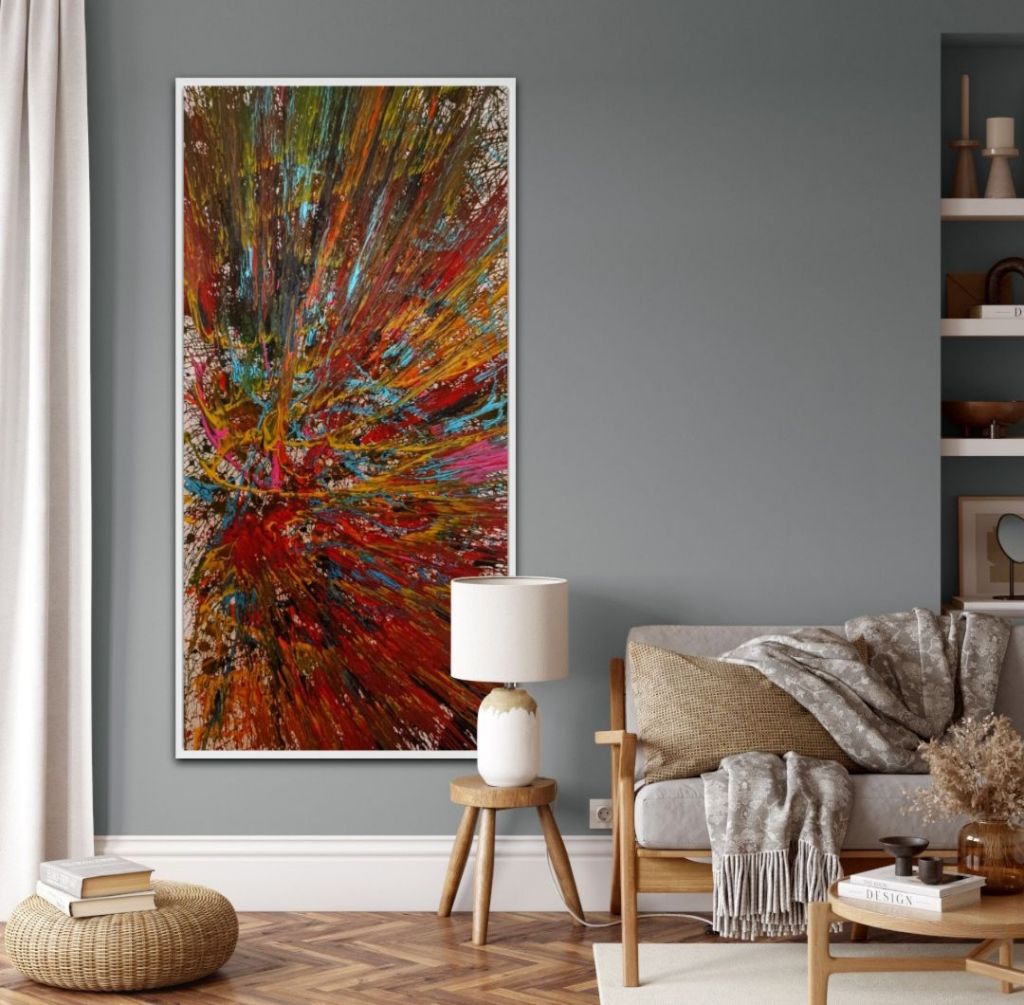
In Kapi Kiše (translated as Raindrops), Mateo Balaban — internationally known by his evocative artistic name Rain Bordo — delivers a visceral explosion of color and motion that straddles the emotional space between chaos and calm. At first glance, the canvas seems wild, almost aggressive, with streaks of red, amber, turquoise, cobalt, and magenta radiating outward in frenetic motion. And yet, if one stands with it long enough, something miraculous happens: the chaos begins to soften, and a strange, soothing peace emerges.
Like rain trailing down a windshield during a solitary night drive, Kapi Kiše captures the illusion of randomness with profound purpose. The colors, dripping and colliding like streams of water refracting the dim lights of a city, evoke the familiar feeling of being lost in thought — of silence after noise, of emotional release after a storm of the soul.
This is not a painting that demands intellectual interpretation; rather, it feels. The visual texture mimics what our eyes perceive when our minds are too tired to process logic — after a long, heavy day when the only thing left to do is go home. There is a tactile memory embedded here, the kind that you don’t remember until a painting like this shakes it loose.
Despite its explosive energy, Kapi Kiše is not violent. Its tension is emotional, not aggressive. It’s the kind of painting that mirrors inner turmoil in a language that doesn’t need to be translated — streaks of inner conflict, joy, release, confusion, acceptance. One can almost hear the patter of droplets on the car roof. One can almost see streetlights blur through wet glass.
Balaban’s choice of vertical elongation emphasizes this downward movement — the pull of gravity, of time, of thoughts sinking into introspection. The paint seems to move like rain itself: unpredictable yet consistent. The splatters are deliberate, carefully placed to mimic disorder, like memories flashing through a foggy mind.
Rain Bordo has always been a master of emotion-over-form, but in Kapi Kiše, he reaches a new level of vulnerability. Here, abstraction becomes intimacy. There’s a confession in this canvas, but it’s not spoken — it’s felt. It’s the ache of being human, and the comfort of remembering that chaos, too, can be beautiful.
This is not a storm. This is the peace after the storm — the music of raindrops on glass, the hypnotic lull that pulls you inward, deeper, safer.
And so, Kapi Kiše is not just a painting. It’s an experience. It’s a reminder that not all clarity comes through stillness. Sometimes, it comes through the blur — through color, through motion, through the falling of rain on your way home. 🌧️🖤✨
By placing emotion at the center of abstraction, Rain Bordo transforms the chaotic into the meditative.
 Rain Bordo