Critical Analysis of the Painting by Mateo Balaban, Known as Rain Bordo
Mateo Balaban, known by his evocative pseudonym Rain Bordo, continues to expand the lexicon of contemporary emotional abstraction with this visually electrifying and psychologically loaded painting. This work—an explosive fusion of chaos and control—presents a visceral confrontation between the internal world of the artist and the external, often indifferent, world in which we all navigate.
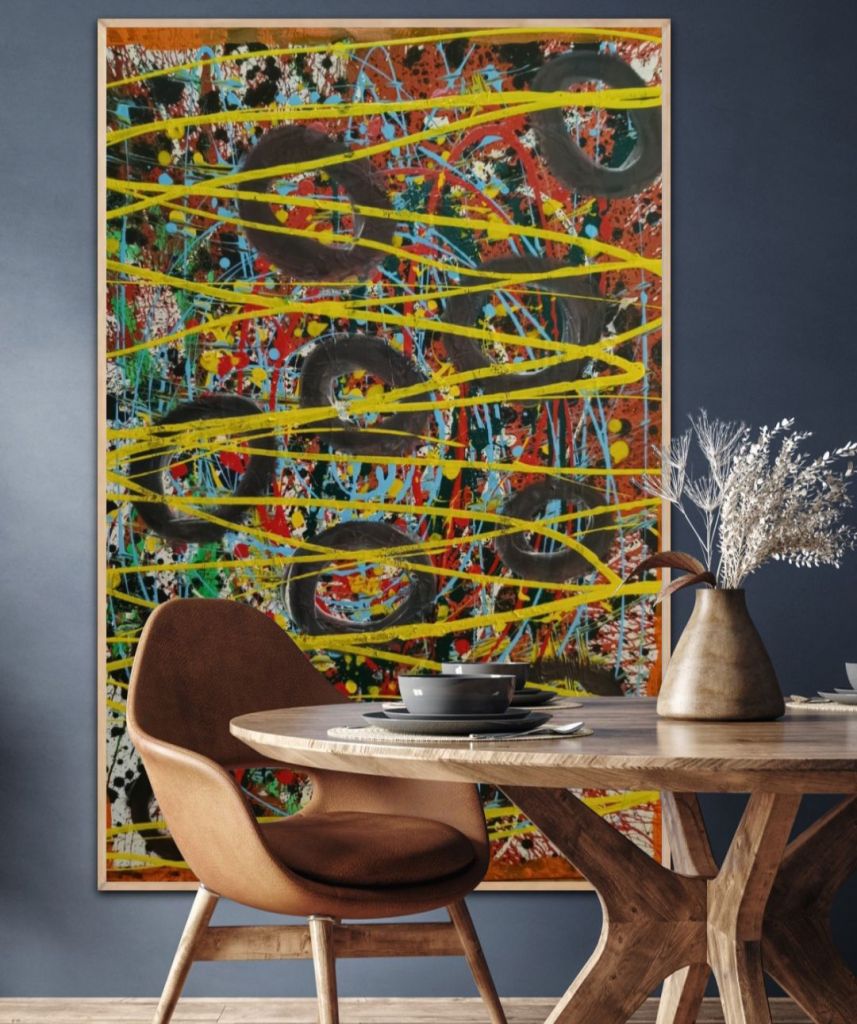
At first glance, the composition is overwhelming: a kaleidoscopic collision of colors, shapes, and gestures. The background pulses with life, drenched in splashes of red, cyan, white, and black—a battlefield of emotions rendered through Pollockian drips and Basquiat-like urgency. The paint isn’t simply applied; it’s attacked, hurled, scratched, and flung in a language of movement and eruption. This method evokes a raw sincerity, a kind of primal truth only possible when the conscious mind steps aside and lets the soul speak through motion.
But then come the interruptions.
Dark circular voids—reminiscent of black holes—punch through the canvas, creating areas of tension, pause, and mystery. These forms feel like questions, or perhaps traumas, orbiting within the painting’s nervous system. They are not just visual motifs, but psychic markers. Some may interpret them as eyes, others as scars, or maybe even mouths screaming in silence. Regardless of interpretation, they resist full understanding, embodying Rain Bordo’s belief that some truths cannot—and should not—be explained.
Strikingly, the work is crisscrossed by aggressive yellow lines that cut through the frenzy like barbed wires or electric fences. They slash across the canvas with the audacity of urgency, forming a dynamic grid that both divides and connects. These lines function like the nervous system’s jolts—reminders of reality in a dreamscape of emotional disarray. Their choice of yellow is no accident. Yellow is at once joyous and alarming; it is the color of sunflowers and hazard signs. Here, it represents a contradiction—perhaps hope imprisoned, or freedom trying to escape.
This painting doesn’t merely hang—it declares. It speaks of modern anxiety, digital noise, emotional overflow, and a desperate, almost sacred, human need to be understood in the storm. There is an implicit violence in its strokes, but also a tender vulnerability that leaks through the chaos. Rain Bordo doesn’t paint what the eye sees; he paints what the heart endures.
The context of placing this piece in an elegant interior with mid-century elements (as seen in the photo) amplifies its message. The juxtaposition of raw expressive abstraction against warm wooden furniture and earthy ceramics creates a psychological contrast: chaos in a space of calm, turmoil in a frame of control. This contradiction mirrors the essence of human life—we present calmness while internally negotiating storms.
In the end, this painting does not offer resolution. It is not a window, but a mirror. The viewer is forced into participation, challenged to interpret, feel, and confront their own inner noise. This is Rain Bordo’s gift and his challenge to us.
🟥 Verdict:
Rain Bordo continues to affirm his position as a truth-bringer in a world of filters. This painting is not meant to please the eye—it’s meant to stir the soul. It’s a manifesto of emotional authenticity in an era of artificial order. Not everyone will understand it. But those who do, won’t forget it.
🟨 Recommended for collectors who seek not beauty, but bravery in art.
 Rain Bordo