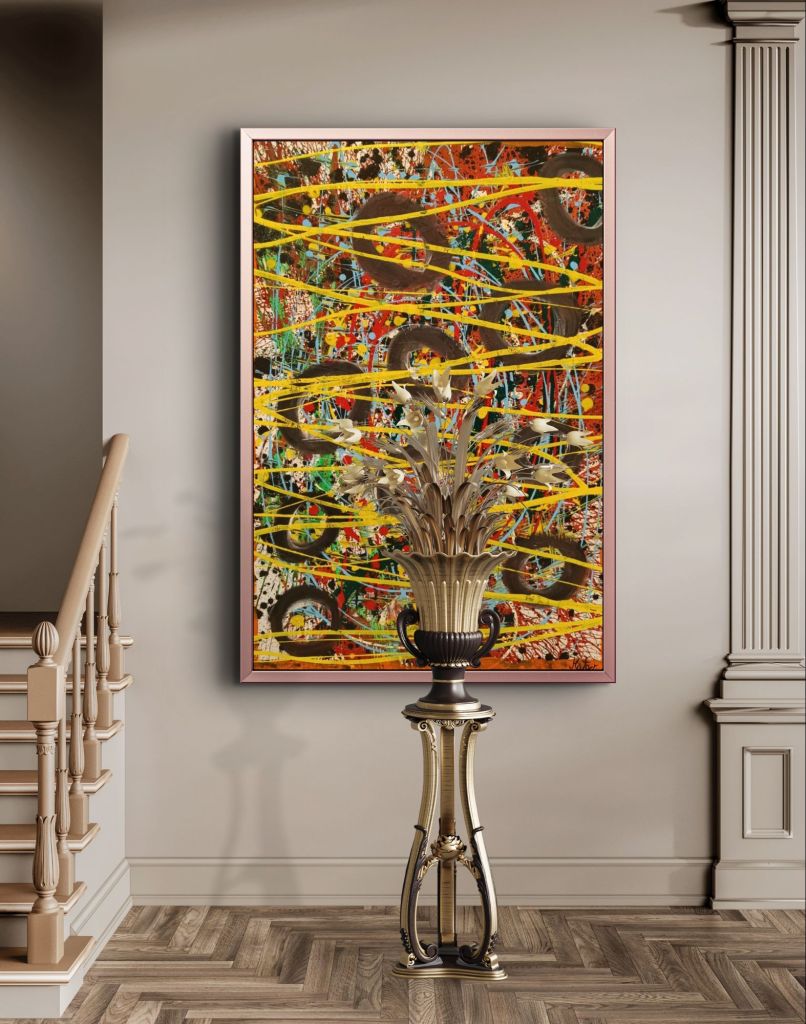
The artwork by Mateo Balaban, known under his artistic name Rain Bordo, radiates a commanding visual intensity — a dialogue between chaos and structure, emotion and order. The painting presents a dense field of color, motion, and texture: a battlefield of layered drips, splashes, and gestural strokes, where yellow lines cut through the composition like threads of nervous energy, binding and dividing the space simultaneously. Beneath this surface tension lies a complex lattice of reds, greens, blacks, and whites — tones of vitality and conflict — that together form a living pulse of emotion.
At first glance, the viewer is struck by the physicality of the act of painting itself. The strokes are not passive marks; they are records of movement, of bodily engagement. Every drip and line captures time — the gesture of the artist frozen in pigment. This emphasis on process and energy situates Rain Bordo within a post-abstract expressionist lineage, where the artwork becomes not merely a product, but an event — a choreography of emotion and motion.
Yet unlike the cold detachment of pure abstraction, Balaban’s work breathes with empathetic turbulence. It belongs to what could be described as “bordism”, a spiritual and emotional current that emerges from his ongoing dialogue between empathy, rebellion, and identity — both artistic and human. Bordism is not a formal movement codified by institutions, but a philosophical and aesthetic stance: it is the refusal of numbness, the revolt against indifference. The “bordo” (deep red) that symbolizes this stance is not merely a color — it is the hue of human vulnerability, of blood and warmth, of life lived at its most sensitive and raw.
In this painting, that bordo essence is everywhere — sometimes literal in tone, but more profoundly symbolic in the emotional temperature of the composition. The thick yellow strokes that slash across the image are not acts of destruction but gestures of containment, as though the artist is attempting to weave coherence into the chaotic multiplicity of existence. The circular forms, emerging like echoes beneath the surface, could be read as portals — openings toward memory, toward the internal world that Rain Bordo often treats as his true subject.
The Movement and the Gesture
Rain Bordo’s work exists in an intersection between Abstract Expressionism, Art Informel, and Emotive Abstraction, yet it resists confinement to any of these. His is a movement of empathy through abstraction, a visual extension of the same philosophy that governs his poetry and prose — especially in his book Kiša Bordo and his reflections on the emotional state of the modern soul. While Pollock or de Kooning sought liberation through the unconscious gesture, Rain Bordo seeks reconciliation through emotional truth. His abstraction is not automatic; it is deliberate, moral, and human.
Every motion on the canvas carries a pulse of human experience — a hand trembling between despair and beauty. The layering of color, particularly the interplay of warm reds and yellows against darker voids, creates a sense of vibration, almost musical, as though each hue participates in an orchestral empathy. The eye moves rhythmically, dancing along the drips and splashes that refuse to settle. There is restlessness, but also a strange serenity that emerges from the tension.
The Spiritual Dimension of Bordism
“Bordism,” as embodied here, is more than visual art — it is a spiritual rebellion against the numb modern condition. It demands that the viewer feel, that one re-engage with the inner world of compassion and perception. The chaotic yet harmonious surface of the painting mirrors the psychological architecture of empathy itself — fractured, layered, ever-changing, yet fundamentally connective. The yellow lines function as bridges — visual veins through which emotion flows across the canvas.
In the broader context of art movements, this can be seen as part of a neo-humanist abstraction: a resurgence of art that seeks to restore emotional resonance in a world saturated by digital superficiality. Rain Bordo’s “bordism” could therefore be interpreted as a counterpoint to minimalism or conceptual detachment — an assertion that art must again risk sincerity.
Form and Composition
Technically, the composition displays a masterful understanding of visual rhythm and balance. The yellow diagonal sweeps operate as both compositional anchors and energetic ruptures. They move in serpentine trajectories, binding disparate visual moments together into a single, pulsating field. The circles and ovals that recur throughout the piece might symbolize continuity, recurrence, or the cyclical nature of emotion — wounds reopening, healing, then reopening again.
Beneath the abstract façade lies a psychological cartography — an emotional map of the human interior. The thick impasto and layering suggest time, memory, and the accumulation of lived experience. The painting, therefore, operates as both a mirror and a confession: the artist’s internal landscape externalized through pigment.
Empathy as Aesthetic Law
In Rain Bordo’s visual and literary world, empathy is not sentimentality — it is resistance. His paintings are sites where feeling is reclaimed as a radical act. The viewer is drawn into this aesthetic of care, where color becomes the language of shared suffering and shared hope. The “bordo” tone, even when absent from the literal palette, remains as an emotional undercurrent — a metaphysical color representing the pulse of humanity that runs through every mark.
The juxtaposition of violent motion and delicate chromatic balance encapsulates the ethic of the bordist movement: to confront the world’s chaos with sensitivity, to transform disorder into compassion. The brush does not dominate the surface; it converses with it. The resulting image is not a statement but a question — an invitation to see, to feel, to remember that art’s ultimate purpose is human connection.
Conclusion
This painting by Mateo Balaban (Rain Bordo) stands as a monumental expression of the bordist philosophy — a movement rooted in emotional truth, empathetic rebellion, and the unrelenting pursuit of sincerity. Its swirling energies, its defiant yellows cutting through a storm of color, embody the tension between destruction and creation, despair and hope.
It is an artwork of movement — not only in the gestural sense, but in the existential one: movement toward empathy, toward awakening, toward the rediscovery of the human heart in an age that risks forgetting it.
In this way, Rain Bordo’s art is not just seen — it is felt, lived, and remembered. It belongs to the timeless lineage of artists who believe that beauty is not escape, but engagement; that every stroke of paint can still whisper, in the face of chaos, a single human truth:
“Empathy prevails.” ❤️
 Rain Bordo