♥️
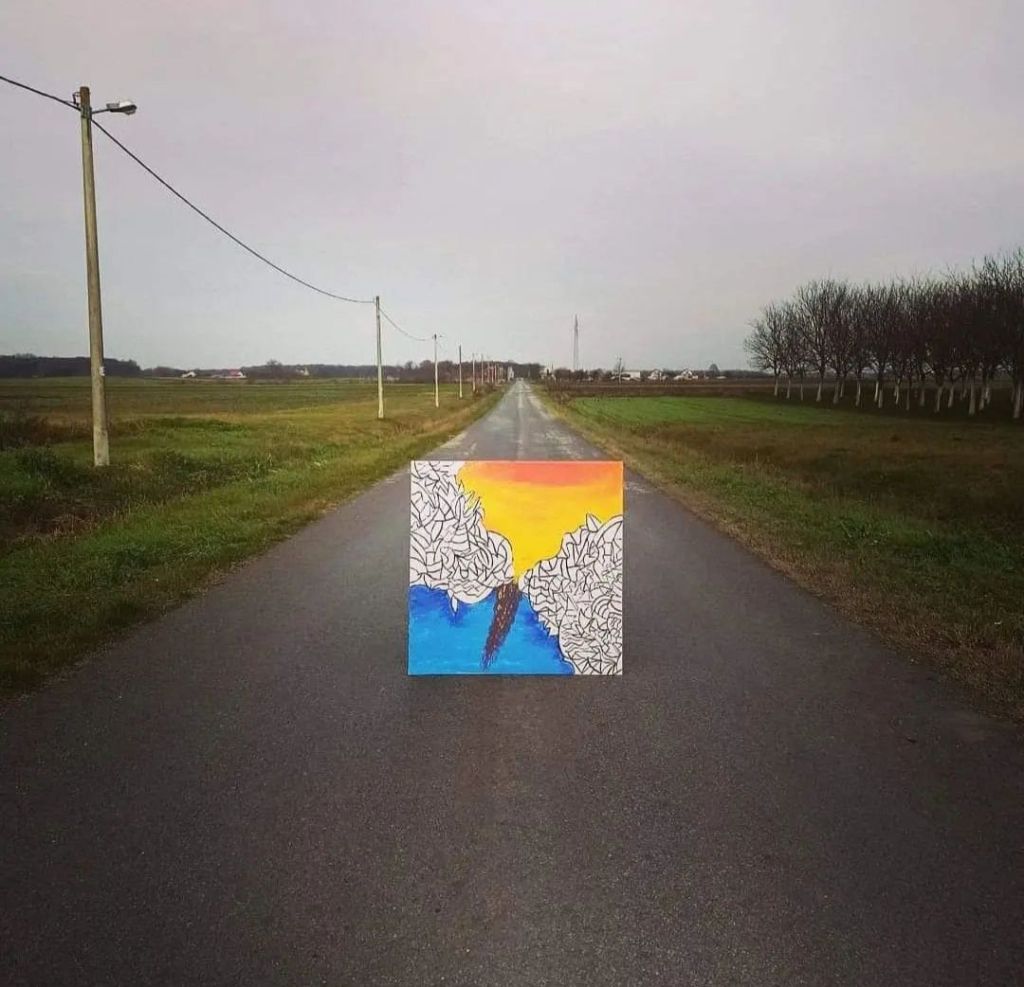
The photograph of Mateo Balaban’s (Rain Bordo’s) painting placed in the middle of an empty, endless road is a deeply poetic gesture — one that resonates profoundly with Jack Kerouac’s On the Road. Both Balaban and Kerouac explore the idea of the journey not as a means to an end, but as an existential condition — a state of becoming, of searching, of being in motion even when standing still.
In this image, the road stretches infinitely forward, a symbol of time, solitude, and the unknown — all central motifs in Kerouac’s writing. Yet, Balaban interrupts this continuity with his painting: a vivid, structured square of emotion amid the vast realism of the world. The canvas becomes a rupture in the monotonous horizon — a declaration that art itself is a road, one that transcends geography and touches the inner landscapes of the self.
Kerouac’s road is internal as much as it is external. His characters chase meaning through motion — the rhythm of wheels, the repetition of miles, the ache of passing towns. Balaban mirrors this with his color and line: the road on which the painting stands becomes the literal and metaphorical ground from which creativity arises. The painting’s division — blue below, yellow above, a cascade of organic white forms between — suggests the meeting of worlds: sky and earth, thought and feeling, freedom and confinement. It visualizes what Kerouac wrote: “The road must eventually lead to the whole world.”
Balaban’s act of placing the painting on the asphalt transforms the road into a gallery of existence. It’s as if the painting is both a mirror and a continuation — a reminder that even the endless road needs a heartbeat, a human intervention, a trace of empathy. The road, often seen as desolate, becomes sacred through this insertion of art, much like Kerouac’s prose sanctified the mundane highways of America.
In essence, Rain Bordo’s image captures the Kerouacian spirit: the tension between solitude and connection, between the need to move and the need to pause. The horizon suggests infinity, but the painting commands attention to the present — the “now” that Kerouac sought but could never hold.
Both artists, in different mediums, articulate the same truth: that the journey is the artwork, and the artwork is the journey. The road is not simply something to be traveled — it’s something to be understood, inhabited, and transformed by the human soul.
Balaban’s square of color is not blocking the road; it becomes the road’s heart — a silent metaphor for what Kerouac called “the holy contour of life.”
 Rain Bordo