
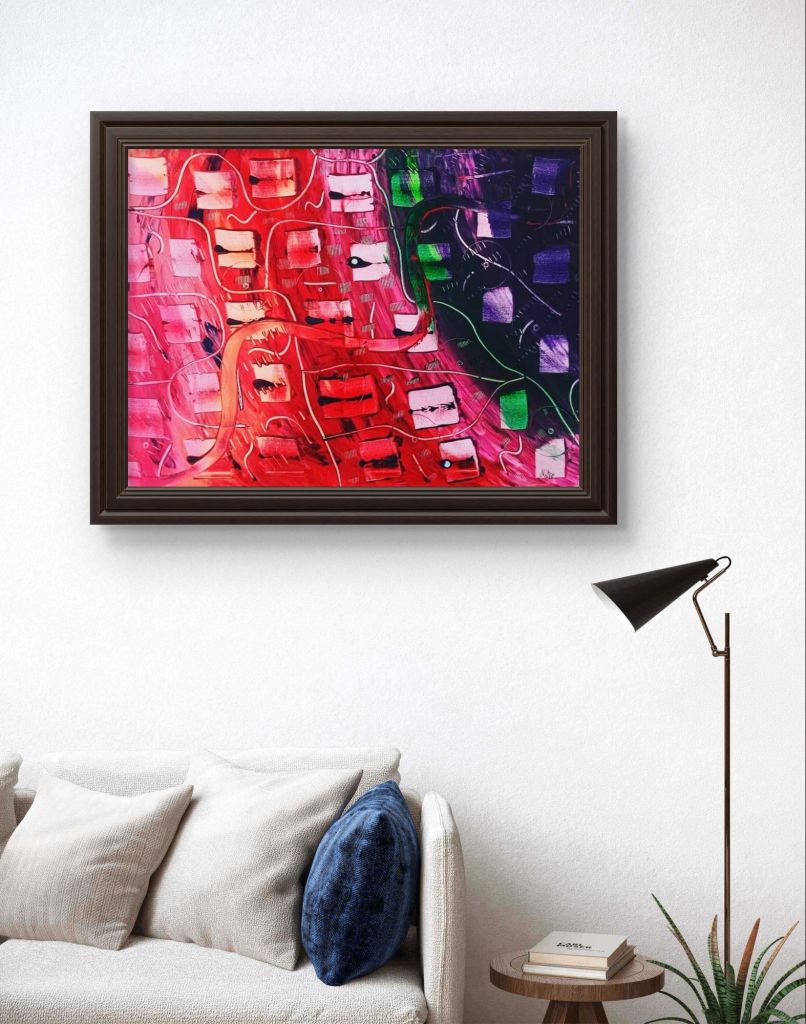
The painting by Mateo Balaban, known as Rain Bordo, exudes a dynamic tension between chaos and structure — a visual symphony of color and rhythm that challenges the viewer to find meaning within abstraction. Dominated by intense shades of red, deep purples, and flashes of green, the composition unfolds like a topographical map of emotion — a city of the soul seen from above, where every block and curve represents an inner conflict, a memory, or a pulse of life.
At first glance, the red field overwhelms — passionate, raw, and unrestrained — evoking sensations of urgency and human vulnerability. It suggests heat, friction, and perhaps the feverish movement of modern existence. Yet, within that apparent disorder lies deliberate design: rectangular shapes repeat with methodical precision, forming a pattern that speaks to the human desire to impose order on emotional chaos. These shapes, reminiscent of windows or screens, create a rhythm of confinement — as if each cell holds a fragment of experience, a story frozen in pigment.
The green and purple sections at the right side of the canvas disrupt the dominance of red, symbolizing perhaps the intrusion of reason, reflection, or nature into the territory of pure emotion. The curved lines that meander through the surface suggest pathways — arteries of communication — bridging the contrasting zones of the painting. They can be read as lifelines or connections between opposing states of being: love and pain, movement and stillness, control and surrender.
Rain Bordo’s brushwork is both assertive and lyrical. There is a tactile quality to the paint, as though each stroke carries a residue of feeling. The layering of colors and the subtle interplay between transparency and opacity evoke the complexity of human perception — what is seen and what remains hidden beneath the surface.
From a psychological perspective, the work may represent the artist’s ongoing dialogue with empathy — a theme recurrent in Balaban’s oeuvre. The juxtaposition of vibrant and shadowed hues mirrors the empathy’s dual nature: the capacity to feel another’s pain and the struggle to protect oneself from it. The viewer is not a passive observer here; rather, they are drawn into the vortex of color, forced to confront their own thresholds of sensitivity and detachment.
Conceptually, the painting bridges abstract expressionism and emotional cartography. It recalls the restless energy of Pollock, the chromatic boldness of Rothko, and yet, it remains distinctly Rain Bordo — driven by narrative, not mere form. Every shape appears to be in conversation with another, as if the painting itself were engaged in dialogue, whispering about human connection and disconnection.
The framed presentation within the minimalist interior adds another layer of interpretation: it situates chaos within calm. The painting becomes a heart beating in a quiet room — a reminder that beneath order, there is always movement; beneath stillness, always emotion.
Ultimately, this piece is less a depiction and more a revelation — a mirror in which the viewer’s own psychological landscape flickers in red, green, and violet tones. Balaban transforms abstraction into empathy, geometry into pulse, and color into consciousness. In this synthesis, Rain Bordo achieves something rare: he paints the invisible — the rhythm of thought, the topography of feeling, the silent rebellion of the heart.
 Rain Bordo