
# Critical Analysis: “Eksplozija emocija” (Explosion of Emotions) by Mateo Balaban (Rain Bordo)
Mateo Balaban, working under the pseudonym Rain Bordo, presents a visceral exploration of inner turmoil in “Eksplozija emocija,” a work that exemplifies contemporary abstract expressionism’s capacity to externalize psychological states through gestural violence and chromatic intensity.
## Technical Execution and Method
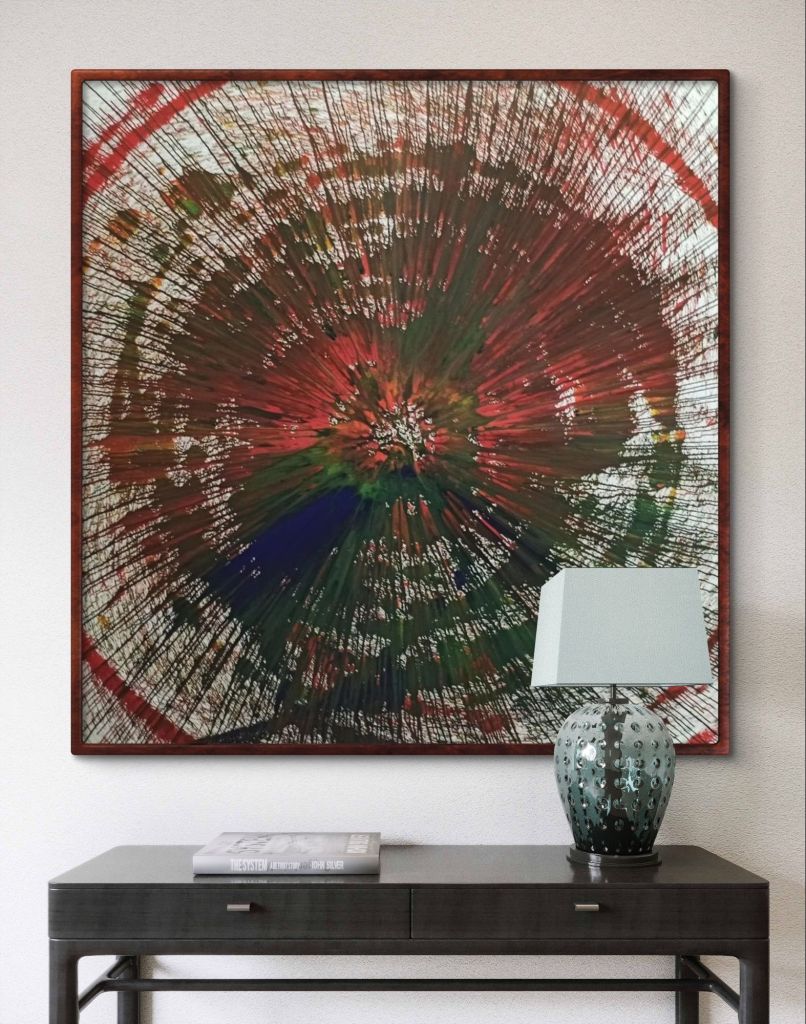
The piece employs what appears to be a spin art or centrifugal technique, where paint is flung from a central axis outward across the canvas. This process-driven approach recalls both Jackson Pollock’s action painting and Damien Hirst’s spin paintings, yet Balaban imbues the method with distinctly personal emotional urgency. The radiating lines create a kinetic energy that refuses to be contained by the canvas edges, suggesting emotions that exceed their boundaries.
The color palette—dominated by reds, deep greens, blacks, and earth tones punctuated by unexpected blues and ochres—evokes a psychological landscape oscillating between passion, anger, decay, and moments of clarity. The red tones, particularly concentrated in certain vectors, read as wounds or ruptures in consciousness, while the darker passages suggest depression or introspection.
## Compositional Dynamics
The centrifugal composition creates a paradoxical tension: while the explosion emanates from a center point, the viewer’s eye is simultaneously pulled inward and thrust outward. This creates a vertiginous experience that mirrors emotional overwhelm—the sensation of being both the source and victim of one’s own feelings. The white background, visible through the gestural marks, functions as negative space that refuses to be completely consumed, perhaps representing rationality or stillness threatened but not entirely obliterated by emotional chaos.
The linear quality of the radiating marks, achieved through the centrifugal force, creates a sense of temporal unfolding—emotions not as static states but as explosive events with trajectories and consequences.
## Conceptual Framework
“Eksplozija emocija” operates within the tradition of art as catharsis and documentation of psychological experience. The title’s directness is matched by the work’s visual aggression, refusing the viewer comfortable aesthetic distance. This is emotion as rupture, not as contemplative melancholy.
The work raises questions about control and surrender in artistic practice. The spin technique requires the artist to relinquish precise control over paint placement, allowing physics and chance to collaborate in image-making. This methodology becomes metaphorically resonant when addressing emotions—those forces that similarly resist rational control.
## Cultural Context
Within the contemporary Croatian art scene, Balaban’s work participates in a broader conversation about expressing subjective experience in an increasingly fractured world. The explosive, almost violent aesthetic registers anxiety, intensity, and the difficulty of containing contemporary emotional life within traditional frameworks.
The piece also engages with questions of authenticity in abstract expressionism. By employing a mechanized technique (spinning) rather than purely gestural mark-making, Balaban paradoxically achieves an authentic rendering of how emotions can feel mechanistic, automatic, beyond conscious direction.
## Critical Considerations
While the work succeeds in creating immediate visceral impact, one might question whether the technique risks becoming decorative or predictable—the spin method, while effective, is perhaps too democratized to carry sustained conceptual weight without additional layers of meaning. The work’s power relies heavily on scale, color relationships, and the framing of intent rather than on innovative formal investigation.
Additionally, the presentation matters significantly. Photographed here in a domestic setting above a console with decorative objects, the work risks being aestheticized, its aggressive content domesticated into interior design—a fate that haunts much contemporary abstract art.
## Conclusion
“Eksplozija emocija” succeeds as both a document of psychological intensity and as a formally compelling abstract composition. Balaban demonstrates understanding of how technique can embody concept, how surrender to process can paradoxically achieve control over meaning. The work invites viewers not merely to observe emotion but to experience the disorientation and intensity of overwhelming feeling.
In an era often characterized by emotional repression or digital mediation of affect, Balaban’s unfiltered explosion registers as both brave and necessary—a reminder that emotions remain powerful, unruly forces that resist easy containment or expression. The work doesn’t solve or resolve; it detonates, leaving viewers to navigate the aftermath.
 Rain Bordo