
Analysis of the Image Featuring Mateo Balaban’s (Rain Bordo) Painting
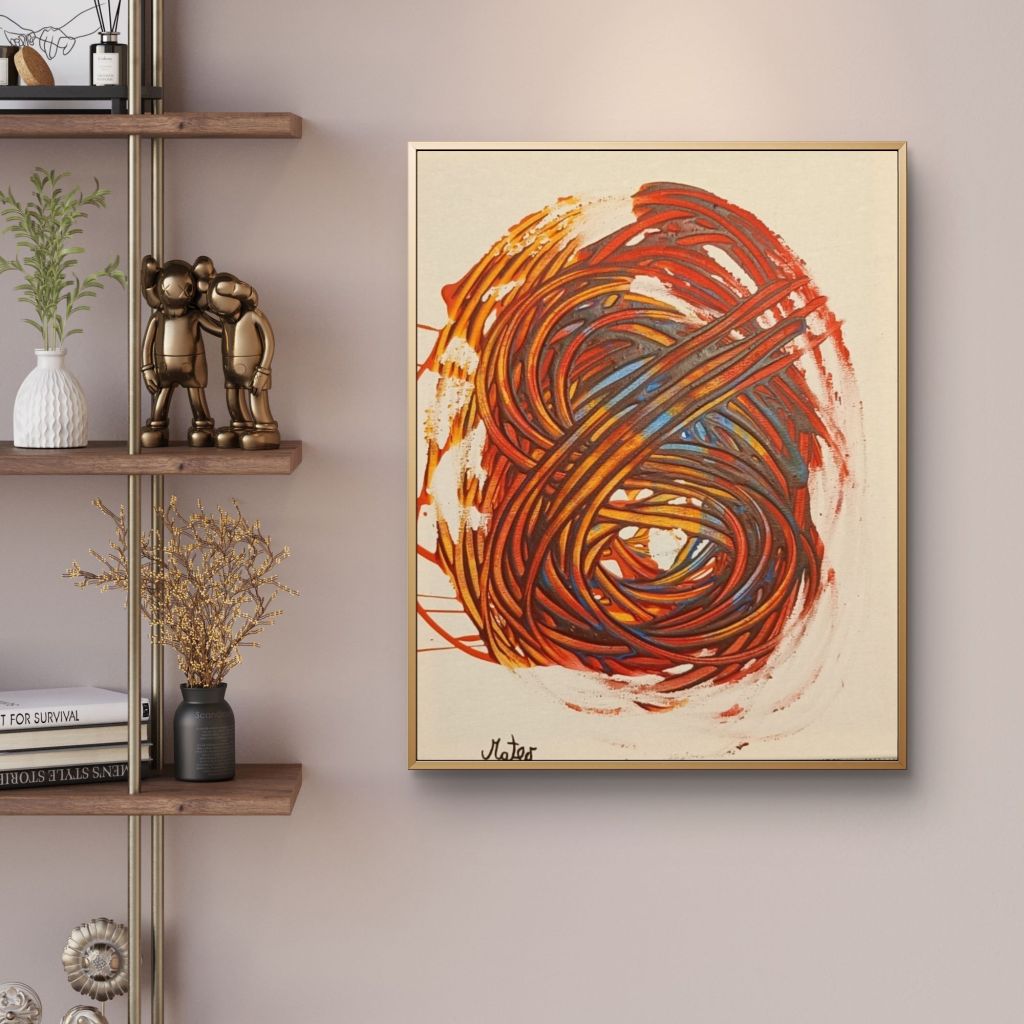
This image captures a meticulously curated interior scene that serves as a stage for showcasing an abstract painting by Croatian artist Mateo Balaban, better known by his pseudonym Rain Bordo. The photograph blends domestic tranquility with the artwork’s raw emotional intensity, creating a dialogue between serene everyday life and turbulent inner expression. Rendered in soft, warm lighting against a pale beige wall, the composition evokes a sense of intimate revelation—art intruding upon the mundane, much like Balaban’s own philosophy of transforming personal pain into unfiltered visual poetry. Below, I’ll break down the image’s elements, with a primary focus on the central painting, its stylistic and thematic layers, and its integration into the surrounding environment.
Overall Composition and Atmosphere
The scene unfolds in a modern minimalist living space, likely a studio apartment or creative nook, dominated by a sleek black metal shelving unit with warm wooden accents. The vertical lines of the shelves provide structural rhythm, echoing the geometric undercurrents in the painting itself. Key decorative elements include:
– **Flora and organic textures**: A lush green potted plant partially veils the lower left of the painting, introducing a veil of life and growth that softens the artwork’s aggression—symbolizing perhaps how trauma (a recurring Balaban motif) coexists with renewal. Nearby, a vase of dried pampas grass adds ethereal fragility, its feathery plumes contrasting the painting’s dense swirls.
– **Sculptural accents**: Two bronze Bearbrick figures (inspired by KAWS-style toy art) stand sentinel on a lower shelf, their playful, humanoid forms injecting whimsy and pop culture into the intellectual space. A white ceramic vase and a small nautilus shell ornament further emphasize natural forms, grounding the abstract energy in tactile reality.
– **Literary nod**: A stack of books on the middle shelf includes *Knjiga za Preživljavanje* (“Book for Survival”), a Croatian title that resonates thematically with Balaban’s work on endurance and emotional resilience. A black matte vase beside it holds a single reed, underscoring themes of solitude and introspection.
– **Lighting and color palette**: Warm ambient light from an unseen source bathes the wall in golden hues, amplifying the painting’s fiery tones while casting subtle shadows that add depth. The overall palette—neutrals, greens, and metallic golds—creates a cocoon-like serenity, allowing the artwork to erupt as the focal point without overwhelming the frame.
This setup feels intentional, almost performative: the room isn’t just a backdrop but a narrative extension of the art, suggesting how Balaban’s creations “invade the viewer’s space” and demand confrontation even in quiet domesticity.
The Painting: Visual Description
At the heart of the image is a large-scale canvas (approximately 24×36 inches, framed in elegant gold), titled *Concentric Radiance with Fractures*. Signed “Mates” in fluid script at the bottom right—a intimate shorthand for Mateo—it dominates the upper two-thirds of the frame. The composition is a hypnotic vortex of interlocking concentric rings, radiating outward from a chaotic, implosive core. Thick, impasto-like strokes build texture, evoking bark, tree rings, or scarred flesh:
– **Color dynamics**: A fiery spectrum transitions from deep crimson reds (suggesting blood and passion) at the edges to blazing oranges and yellows toward the center, punctuated by bursts of white for rupture and surrender. Two stark blue diagonals slash across the form like surgical incisions or veins of alienation, disrupting the warm symmetry and injecting cool, logical interruption.
– **Form and movement**: The rings are serrated and “tooth-like,” not smooth orbits but jagged fractures that propel the eye inward, only to rebound in centrifugal force. No central figure anchors the gaze; instead, a void at the nucleus creates a magnetic pull, drawing viewers into an emotional black hole.
– **Medium and scale**: Acrylic or mixed media on canvas, the work’s raw edges and visible brushwork reject polish, favoring visceral immediacy. In the gold frame, it gains a classical gravitas, transforming from raw sketch to heirloom provocation.
Visually, it’s a storm contained: explosive yet contained, organic chaos disciplined by geometry.
Stylistic and Thematic Analysis
Balaban, a Croatian poet-painter whose oeuvre blends abstract expressionism with personal memoir, crafts this piece as “emotional mathematics”—a rigorous mapping of psyche where fury masquerades as form. Stylistically, it walks a tightrope between symmetry (the hypnotic circles) and anarchy (serrated breaks and impulsive drips), distinguishing Rain Bordo from peers by infusing geometry with “militant” honesty rather than mere decoration. The texture—visceral and bark-like—recalls natural cycles (growth rings as “years survived”), while the diagonals act as narrative scars, posing the eternal “why” amid grief’s warmth.
Thematically, *Concentric Radiance with Fractures* is autobiographical cartography: a survivor’s manifesto charting trauma’s layers, from outer defenses (fiery alarms) to inner voids (surrendering whites). Reds and oranges scream danger and vitality; blues alienate like “logic through grief.” Absent a protagonist, it universalizes the human condition—soul without skin, implosion as expansion. In this domestic context, the partial obscuration by the plant amplifies its invasiveness: art that “refuses to fade,” bleeding into lived space like unresolved memory. Balaban doesn’t paint to soothe; he awakens, turning pain into “visual implosion” that echoes his poetry’s raw cadence.
Integration and Broader Implications
The painting’s placement—high on the wall, partially eclipsed yet inescapably central—mirrors its themes: fractured visibility in survival’s quiet aftermath. The room’s minimalist ethos (clean lines, natural motifs) tempers its ferocity, suggesting art’s role as both mirror and weapon in everyday resilience. For collectors, this isn’t sofa-matching decor but a “conversation starter” and “fight,” demanding emotional reckoning. In Balaban’s world, where personal truth meets collective symbol, this image immortalizes that tension: a sanctuary pierced by radiance, inviting us to trace our own fractures in the glow.
 Rain Bordo