
Critical Analysis of Mateo Balaban (Rain Bordo)’s Artwork
Visual Composition and Technique
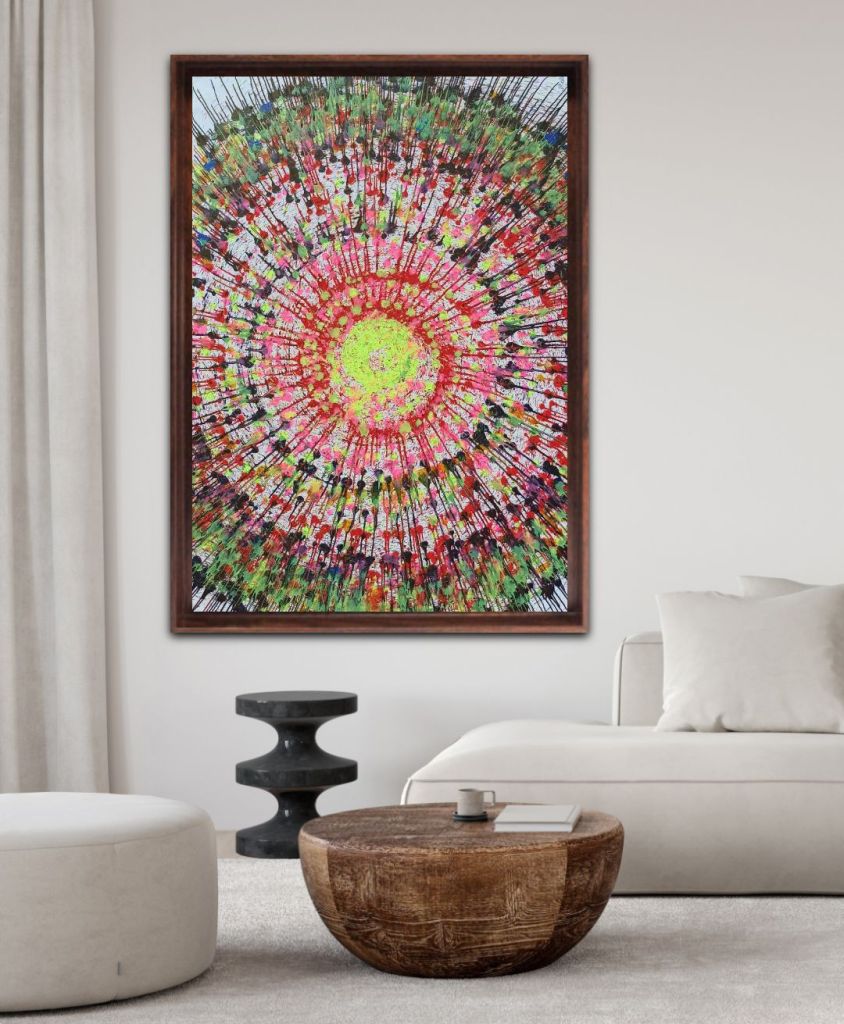
This piece exemplifies Balaban’s signature spin painting technique, a method popularized by Damien Hirst but here executed with distinctive chromatic intensity. The work employs centrifugal force to create a radial composition that explodes outward from a luminous yellow-green core. The artist has layered colors with calculated spontaneity—vibrant pinks, reds, greens, and blacks interact through controlled chaos, creating a dynamic tension between intention and accident.
The technique reveals itself through the characteristic radial striations and paint trajectories. Balaban demonstrates mastery over the spin painting process, balancing the viscosity of different pigments to achieve both sharp linear elements and areas of color bleed. The result is a work that simultaneously embraces and transcends its mechanized production method.
Color Theory and Symbolism
The palette progression from the central yellow-green nucleus through hot pinks and reds to the cooler outer greens and blacks suggests an energetic explosion or perhaps a floral bloom. This chromatic journey from light to dark, warm to cool, creates a sense of both expansion and containment—the energy radiates outward but is ultimately bounded by the frame and the darker peripheral tones.
The neon yellow center acts as the compositional anchor and focal point, drawing the viewer’s eye inward despite the outward thrust of the composition. This creates a visual paradox that keeps the eye in constant motion across the picture plane.
Context within Contemporary Art
Balaban’s work exists at the intersection of process art, abstract expressionism, and contemporary street art aesthetics. While the spin painting technique inevitably invites comparison to Hirst, Balaban’s color sensibility and scale choices distinguish his practice. The work embraces the democratization of art-making through mechanical processes while maintaining aesthetic sophistication.
The piece also engages with contemporary discussions about authorship, control, and the role of chance in artistic production. By embracing a technique that limits direct hand manipulation, Balaban questions traditional notions of artistic skill while simultaneously demonstrating expertise in material manipulation and compositional instinct.
Installation and Presentation
Notably, the work is presented in a warm wooden frame within a minimalist interior setting, creating an interesting dialogue between the explosive energy of the artwork and the calm restraint of its surroundings. This juxtaposition enhances the piece’s visual impact—the vibrant chaos becomes even more pronounced against the neutral backdrop.
The scale appears substantial, allowing the work to command the space while maintaining intimate engagement potential. The viewer can simultaneously appreciate the overall composition and discover intricate details in the paint interactions.
Critical Assessment
Balaban’s work succeeds in creating visually arresting imagery that balances accessibility with conceptual depth. However, questions remain about the piece’s position within the broader trajectory of abstract art. Does the mechanical production method enhance or diminish the work’s authenticity? Is the visual pleasure sufficient, or does the work need additional conceptual scaffolding?
The strength of this piece lies in its unapologetic embrace of color and energy. It doesn’t rely on irony or conceptual obfuscation but instead offers pure visual experience. In an art world often dominated by theoretical complexity, this directness can be read as either refreshingly honest or potentially superficial, depending on one’s critical framework.
Conclusion
This work by Mateo Balaban demonstrates technical proficiency and strong aesthetic instincts. It successfully creates a dynamic visual field that rewards sustained attention while remaining immediately accessible. Whether it transcends its process-based origins to achieve lasting artistic significance will ultimately depend on how it develops within the artist’s broader body of work and how contemporary conversations about mechanical production in art continue to evolve.
 Rain Bordo