“Between the Howl and the Silence: A Curatorial Dialogue between Allen Ginsberg and Rain Bordo”
Between the Howl and the Silence: A Curatorial Dialogue between Allen Ginsberg and Rain Bordo
In the landscape of modern and postmodern art, two voices — separated by half a century, geography, and medium — seem to call to each other across the distance of time: Allen Ginsberg, the American poet who howled against the machinery of a dehumanized century, and Mateo Balaban, known as Rain Bordo, the Croatian painter-poet who paints the silence that follows that howl. Their works are not connected by influence but by emotional inheritance — the persistent struggle to humanize existence through art, empathy, and rebellion. If Ginsberg represented the electric scream of consciousness, Rain Bordo represents the quiet aftermath: the still breath that remains when language itself has been exhausted.
Ginsberg’s Howl erupted in the mid-twentieth century as a cry of the disillusioned, the outcast, the spiritually suffocated. His America was an empire of consumption and repression, where the human soul risked extinction beneath fluorescent lights. Rain Bordo’s world, by contrast, is one that already knows the echo of that extinction — a world in which the scream has become internal, absorbed into the bloodstream of the contemporary psyche. Yet, his art refuses resignation. His paintings and poems — Look at the person next to you, The Silent Cry of Anne Frank, Unknown description of falling texture — do not lament the absence of empathy; they attempt to paint empathy itself, to restore its shape and warmth in a cold visual age.
This dialogue between Ginsberg and Rain Bordo is not about historical continuity but emotional resonance. Both artists are bound by the same ethical pursuit: to awaken the human heart in a time that dulls it. Both refuse indifference — Ginsberg through the urgency of his breath, Rain Bordo through the slowness of his brush. Together they form a bridge between the shouted plea for liberation and the quiet reconstruction of meaning.
Historical and Cultural Context: The Age of the Shout and the Age of the Whisper
To understand the connection between these two artists, one must consider the worlds they inhabited. Ginsberg’s America of the 1950s was a landscape of conformity — a nation recovering from war yet obsessed with progress, capitalism, and moral order. The Beat poets, led by Ginsberg, Kerouac, and Burroughs, sought freedom not just from political systems but from inner cages: fear, repression, apathy. Their poetry was a rebellion against silence, a loud reclamation of the body and the mind.
Rain Bordo’s century, however, begins after the noise has passed. His Croatia — and, by extension, the globalized Europe he inhabits — carries different wounds: disillusionment, digital alienation, and post-war melancholy. Where Ginsberg fought the noise of false morality, Rain Bordo confronts the silence of emotional fatigue. We are no longer oppressed by strict systems of control but by the emptiness of too much information, by a world that scrolls past suffering. Thus, while Ginsberg’s art was an explosion outward, Rain Bordo’s is a descent inward. The first demanded freedom of expression; the second demands freedom of feeling.
In this shift from the collective to the individual, from protest to introspection, lies the heart of their dialogue. Ginsberg’s poetic revolution sought to awaken the mind of the masses; Rain Bordo’s artistic revolution seeks to restore empathy to the isolated soul. One needed to howl to be heard; the other must whisper to be understood.
Thematic Convergence: Rebellion, Empathy, and Chaos
Both artists are revolutionaries, though they use different weapons. Ginsberg’s rebellion was linguistic — a deliberate breaking of poetic form to reclaim the natural rhythm of consciousness. He turned the poem into an extension of the body, each line a heartbeat or a gasp. His rebellion was sensual, mystical, and political all at once. He sought liberation through excess, through the radical inclusion of all that society had deemed unworthy: madness, lust, spirituality, pain. His art was a howl because it carried the urgency of life itself.
Rain Bordo’s rebellion is quieter but no less subversive. In an age saturated by spectacle, he rebels through sincerity. His art refuses irony, detachment, or cynicism — the dominant tones of postmodern culture. Instead, he offers vulnerability as defiance. In works such as The Silent Cry of Anne Frank, the rebellion is not against society alone but against the numbness of history. The painting’s restrained palette, its still surface, and its title’s paradox — a cry that is silent — together create an atmosphere of suspended pain. It is an act of remembrance, but also of transformation: empathy becomes resistance.
In this sense, both artists perform acts of compassion as revolution. Ginsberg’s compassion was ecstatic — a vision of divine interconnectedness where every human being, saint or criminal, shared the same light. Rain Bordo’s compassion is contemplative — it is the gentle act of seeing, of acknowledging the invisible. His painting Look at the person next to you becomes not just a title but a manifesto: art as invitation, not proclamation. Where Ginsberg’s empathy demanded recognition of the oppressed, Rain Bordo’s empathy demands presence — to see, to feel, to remain human despite the mechanization of perception.
Chaos, too, is central to both. Ginsberg sought to find holiness in chaos, to transmute madness into prophecy. His chaos was external — cities, voices, neon signs, ecstatic bodies. Rain Bordo’s chaos is internalized. It lives in texture, in the layered surfaces of his canvases, in the emotional fractures of color. The difference is not of theme but of temperature: Ginsberg burns; Rain Bordo glows. Ginsberg’s chaos shatters language; Rain Bordo’s chaos repairs silence. Both are alchemists of disorder, but one explodes the world to see its core, while the other gathers the fragments to rebuild a heart.
Empathy as a Bridge Between Ages
In tracing empathy through their work, we uncover the most profound link between the howl and the silence. For both, empathy is not a sentiment but a method of knowing — a way of accessing truth beyond rational language. Ginsberg believed that the poet must feel the pain of others as his own, that only through radical emotional transparency could truth emerge. His poetry is a mirror to suffering, but also an embrace of it — an attempt to sanctify the wounded.
Rain Bordo extends that mission into the visual realm. His paintings, often centered on human fragility, are not depictions of pain but embodiments of empathetic perception. In the small dot of light that persists amid his darker compositions, in the muted tones that still hum with life, there is the same spiritual intuition that drove Ginsberg’s words. Yet, while Ginsberg externalized empathy through declaration, Rain Bordo internalizes it through silence and space. His empathy is not heard but seen — and more importantly, felt.
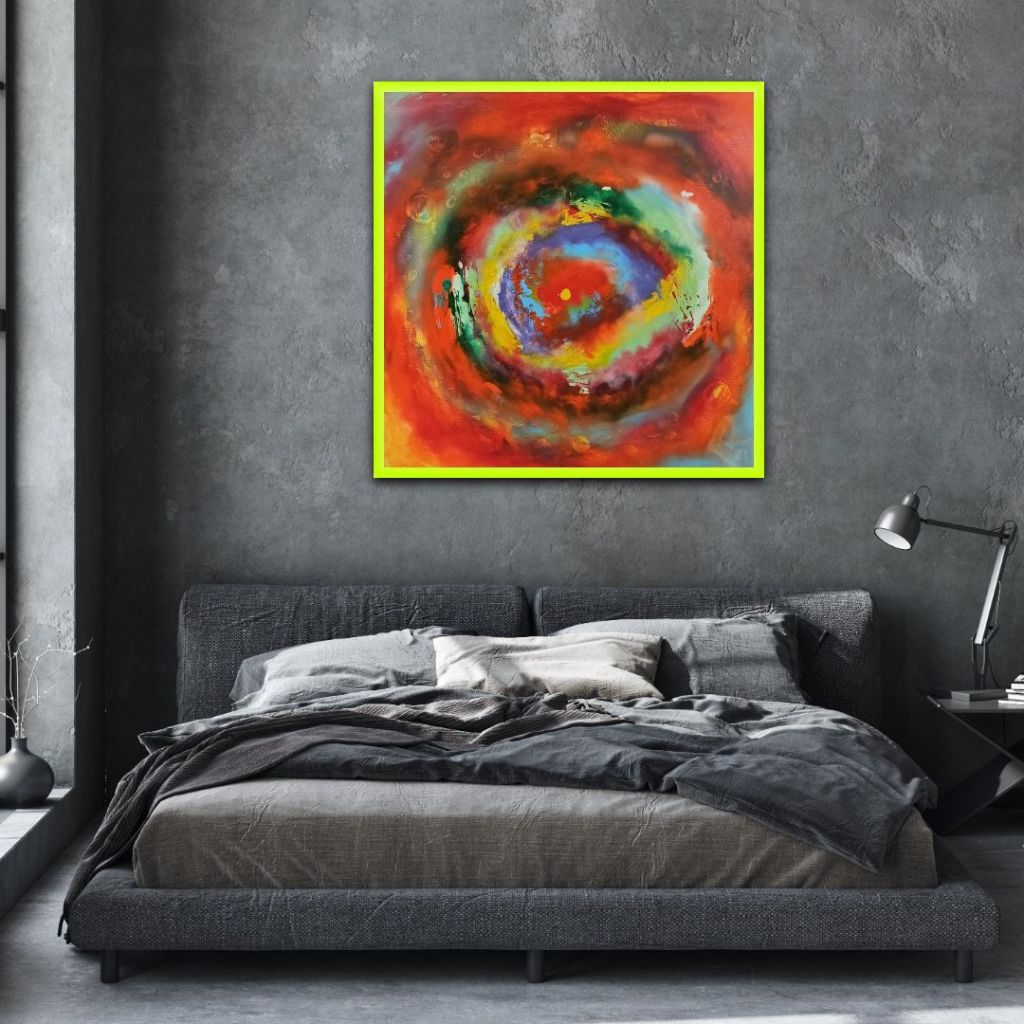
In Unknown description of falling texture, sometimes referred to as the small dot of hope that still exists, we encounter the essence of this philosophy. The painting resists narrative; it speaks in abstract emotional language. Textures descend like memories; colors bleed like voices fading in the distance. But amid that dissolution lies a single point of light — a quiet, almost shy symbol of persistence. It is as if Ginsberg’s voice, once thunderous, has condensed into a single luminous tear. The howl has become a whisper, and the whisper has become the truth.
Though united by their moral and emotional core, Ginsberg and Rain Bordo diverge radically in aesthetic form. Their creative vocabularies arise from different relationships with chaos — one of release, the other of containment. Ginsberg’s poetics rely on an outward motion, a surge that mirrors the uncontrollable rhythms of thought. He breaks syntax, erases punctuation, and expands the poetic line until it bursts with consciousness. The act of writing, for him, is a performance of freedom — a visceral improvisation akin to jazz or spontaneous prayer.
Rain Bordo, conversely, practices a kind of structured vulnerability. His art is not improvised but meditative; his brushstrokes are not bursts but breaths. Every painting, every line of his poetry, seems to arise from silence rather than speech. Where Ginsberg’s creative act is centrifugal — flinging emotion outward into the world — Rain Bordo’s is centripetal, pulling emotion inward until it condenses into an image, a color, a gesture. He works not through expansion but through distillation: the compression of vast emotional experience into a single symbolic form.
This aesthetic difference extends to their treatment of rhythm. Ginsberg’s rhythm is organic and performative, drawn from breath and pulse — it exists to liberate meaning. Rain Bordo’s rhythm is visual and contemplative, drawn from pause and stillness — it exists to contain meaning. His paintings create temporal experiences not through motion but through suspension. The viewer stands before his canvas in the same way one might stand before a confession — aware that something deeply human is occurring, yet reluctant to interrupt.
This contrast also defines their relationship to the audience. Ginsberg’s audience was the street — his art sought participation, protest, communion. Rain Bordo’s audience is the solitary observer — the individual capable of listening with the eyes. He asks for attention, not reaction. His rebellion is internal, but its reach is universal, because in a world numbed by immediacy, stillness itself becomes revolutionary.
Spiritual and Emotional Landscapes
At the heart of both artists’ work lies an unrelenting spiritual search. Yet, they travel opposite directions along the same axis. Ginsberg moves upward, toward transcendence through ecstasy; Rain Bordo moves inward, toward transcendence through empathy.
For Ginsberg, spirituality is inseparable from chaos — a cosmic field where the sacred and profane coexist. His art is apocalyptic in tone because it believes in the possibility of revelation within ruin. He exposes the sickness of modern life but also insists that beneath it lies an eternal spark of holiness. His God is fragmented, echoing in factories and city streets, in erotic bodies and decaying minds. To find the divine, Ginsberg must first shatter the human condition.
Rain Bordo’s divinity, by contrast, is quiet and merciful. His spirituality emerges not through the destruction of form but through the healing of it. He does not seek God in noise but in gesture — the tilt of a head, the trembling of a brushstroke, the fragile balance between light and shadow. His faith resides in the possibility that empathy itself is divine. To look at one of his paintings is to experience a kind of prayer — not for salvation, but for connection.
This is evident in Look at the person next to you, where a simple imperative becomes a spiritual act. The painting’s title could easily be mistaken for a social slogan, yet within Rain Bordo’s context, it becomes a commandment of compassion. To “look” is not merely to see; it is to acknowledge the shared miracle of existence. This gesture — humble, human, immediate — encapsulates the entire theology of Rain Bordo’s universe. Where Ginsberg sought transcendence through the expansion of awareness, Rain Bordo achieves it through attention.
In this inversion, we find the emotional maturity of Rain Bordo’s era. The 20th century demanded prophets; the 21st demands healers. Ginsberg screamed to awaken humanity; Rain Bordo listens to soothe it. The howl has become the heartbeat.
To compare Ginsberg’s poetry with Rain Bordo’s visual art is to explore two different languages striving toward the same truth. Both artists, in their own way, attempt to make emotion visible — one through syntax, the other through texture.
Ginsberg’s poetry relies on the elasticity of words: his metaphors bend reality, his rhythm mimics breathing, his voice becomes a vessel of raw sensation. The reader is pulled into a storm of associations, sensations, and revelations. His art is kinetic — it moves, sweats, vibrates.
Rain Bordo’s art, meanwhile, transforms that same intensity into a spatial experience. His paintings speak in the grammar of light. Color replaces word; space replaces rhythm. What Ginsberg accomplishes through the accumulation of language, Rain Bordo achieves through reduction — through what is not said but suggested. In front of one of his canvases, the viewer does not “read” meaning; they absorb it.
This transfer of emotional language from text to image reveals a profound evolution in the artist’s role. Ginsberg demanded participation; Rain Bordo demands reflection. Both, however, insist on truth as intimacy. In the presence of their work, one cannot remain detached. Ginsberg’s long lines drag you into empathy; Rain Bordo’s quiet colors dissolve your defenses until you feel rather than think.
Their methods differ, but their goal is identical: to restore the possibility of feeling in a disenchanted world. Rain Bordo’s visual poems are therefore not descendants of Ginsberg’s words but their continuation in another medium — a new alphabet for the same emotion. Where Ginsberg used rhythm to translate experience into revelation, Rain Bordo uses hue, shape, and silence to translate revelation back into experience.
In The Silent Cry of Anne Frank, this is particularly evident. The painting does not illustrate history; it recreates empathy. The figure of Anne becomes a symbol not of tragedy but of endurance. The painting is not loud — it hums. Its silence carries the same moral force that Ginsberg once carried in his protests. It is not an accusation but a reminder: empathy is the last form of resistance.
The Curatorial Perspective: Between the Howl and the Silence
As a curator standing between these two worlds — between the electric page of Ginsberg and the contemplative canvas of Rain Bordo — one feels both tension and continuity. They are two halves of a larger conversation about what it means to remain human in the face of dehumanization.
Ginsberg spoke to a century that had lost its voice; Rain Bordo speaks to a century that has lost its heart. Yet, both confront the same absence — the erosion of empathy. Their art serves as a map of recovery. Ginsberg’s map is wild, uncharted, filled with the noise of awakening. Rain Bordo’s map is minimalist, a topography of silence where one learns again how to listen.
In curatorial terms, their dialogue reveals the transformation of artistic empathy across generations. In Ginsberg’s era, empathy required confrontation; in Rain Bordo’s, it requires contemplation. The museum or gallery space, then, becomes a sanctuary for this evolution — a place where the visitor, surrounded by the hush of Rain Bordo’s work, may still hear the distant echo of Ginsberg’s voice, softened but alive. The howl becomes a whisper not because the world has quieted, but because art has matured enough to express pain without shouting.
Conclusion: The Continuum of Human Witness
To place Allen Ginsberg and Rain Bordo side by side is to witness the transformation of artistic responsibility — from the public to the intimate, from revelation to restoration. Both artists teach us that the essence of art is not beauty, but presence: the courage to feel, to see, to remain awake.
Ginsberg’s achievement was to break the walls of language so that truth could enter. Rain Bordo’s achievement is to build spaces of silence so that truth can stay. The former taught us that freedom begins in the act of speaking; the latter reminds us that freedom survives in the act of listening.
In the end, their dialogue forms a single continuous gesture — a movement from voice to vision, from the outer rebellion to the inner redemption. The howl of Ginsberg called humanity to awareness; the silence of Rain Bordo calls it to compassion. Both are necessary. Both are holy.
Standing before Rain Bordo’s painting, one feels the afterglow of Ginsberg’s century — the lingering warmth of words that once set fire to the world. Yet, in that same stillness, one also feels a new possibility: that empathy, quietly sustained, might heal what revolution alone could not.
This is the bridge between them — not of form or style, but of purpose. To awaken the human heart is the highest function of art. Ginsberg’s cry demanded it; Rain Bordo’s silence fulfills it.
And somewhere, between the howl and the silence, art begins again.
🌧️
 Rain Bordo