Mateo Balaban, performing and painting under the name Rain Bordo, is an artist who refuses to separate his pain from his hope. In both his music and his visual art he returns, again and again, to the same wound: the experience of being treated as less-than-human because of race, class, or simply because someone with power decided you do not count. What makes his work so moving is not anger alone (though anger is there), but the tenderness with which he protects innocence while still speaking the full truth.
The song “Polja od pamuka” (Cotton Fields) is a slow-burning blues-rap lament that gradually becomes a revolutionary anthem. Sung from the collective voice of seven exhausted workers bent under the sun and the overseer’s whip, it is impossible not to hear the echoes of American spirituals like “Go Down, Moses” or the field hollers that gave birth to the blues. The repeated refrain — “Tvrd je bič našega gospodara…” (“Hard is the whip of our master…”) — functions like a work-song call-and-response, each repetition grinding deeper into the body until the final verses explode into the chant “Sloboda! Sloboda! Sloboda!” (Freedom!). The arc is classic: suffering → awakened dignity → collective revolt → fragile, hard-won joy. What saves the piece from cliché is its intimate scale (only seven workers) and its refusal of heroic individualism. Victory is not won by a single savior but by solidarity: “imamo jedni druge” — we have each other.
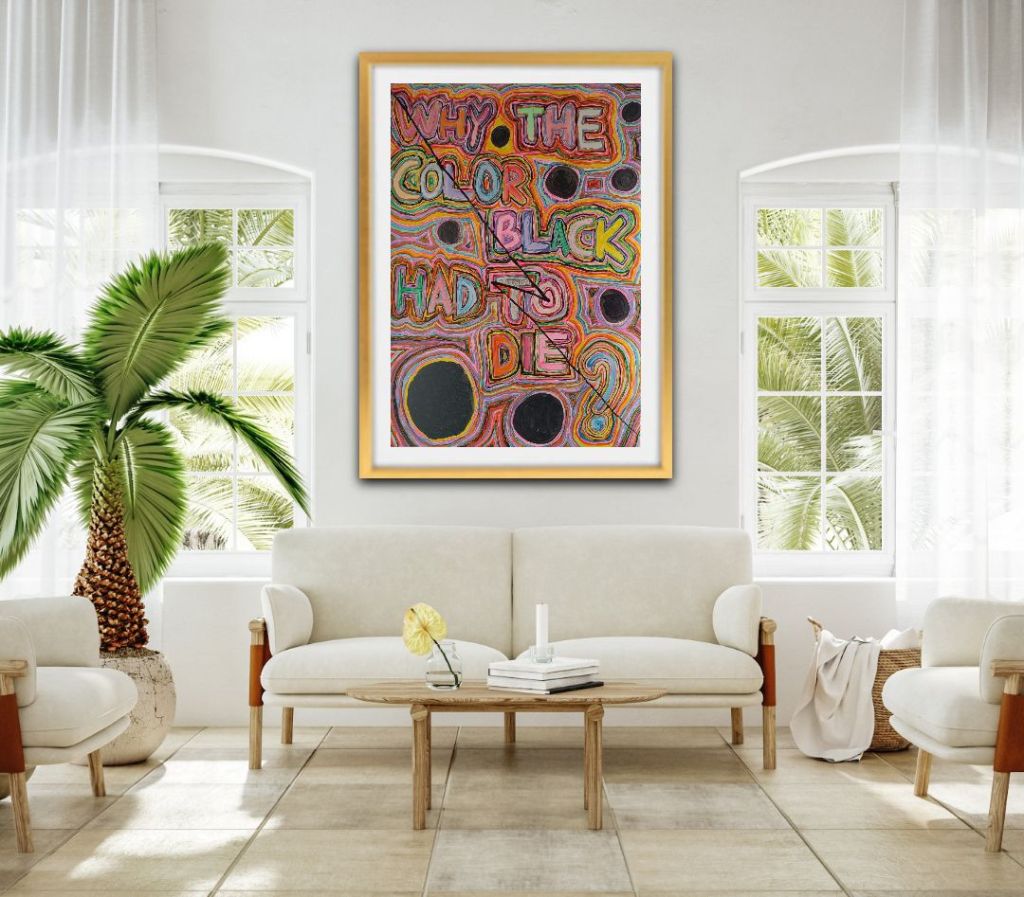
Across the room from this song hangs the painting “Why the Color Black Had to Die?” — the first panel of a triptych, explicitly painted from a child’s perspective. The canvas is a riot of candy-colored swirls — pinks, yellows, turquoises, oranges — like a child’s marker drawing gone deliriously large. Scattered across this carnival are perfectly round, matte-black holes, some edged with dripping rainbow borders, as if the black circles are wounds in the paper itself. Over the top, in uneven kindergarten capitals, the question is scrawled three times:
WHY THE
COLOR
BLACK
HAD TO
DIE?
There is something heartbreaking in the way the letters wobble. The child does not yet understand racism as a system; they only know that someone, somewhere, decided that one of the colors in their crayon box is bad, dangerous, unworthy of life. The black circles are not evil — they are simply there, neutral and beautiful in their perfect roundness — yet the adult world has declared them guilty. The rainbow chaos around them feels like an attempt to drown the black out with forced cheerfulness, or perhaps like a child frantically trying to make the world pretty again after overhearing something cruel.
When you place the song and the painting side by side, the dialogue between them is devastatingly clear.
In “Polja od pamuka” the workers’ skin is never explicitly racialized in the lyrics, but the imagery — cotton fields, the whip, the master who returns “to the earth he came from” (a poetic way of saying the oppressed finally bury their oppressor) — carries centuries of Black trauma in the African diaspora. The song is sung by adults whose bodies have been broken by the equation “black skin = labor animal = disposable.” The painting, meanwhile, returns to the moment before that equation is learned. It is the same story told backwards: the song shows what happens when the question “Why must black die?” is never answered with love; the painting shows the innocence that is murdered first.
Bordo’s genius is that he refuses to let either work resolve the pain for us. The song ends with a fragile hope (“We have each other… let’s go into a new life”), but we know the cycle of masters and whips is long. The painting ends with a question mark, not a period. The child is still waiting for an answer that the adults in the song never received. Together they form a diptych of intergenerational grief: the child asks why blackness must be killed; the workers spend their lives proving that it does not have to be, yet still bleed under the whip that insists otherwise.
Musically, I wish we had a recorded version to hear how Bordo delivers the verses — whether he keeps the flow sparse and spoken over minor-key guitar, or layers it with Balkan brass for a sudden major-key lift in the final “Sloboda!” chorus. Even without the recording, the text alone carries the weight of someone who has felt the sun on his own neck and the sting of being told his color makes him less. The painting, meanwhile, succeeds because it never tries to be “pretty” in a comforting way; its childlike style is a trap — the longer you look, the more the black voids feel like bullet holes in a kindergarten drawing.
Both pieces are acts of fierce empathy. The song says to the exhausted worker: I see you, your dignity is real, rise up. The painting says to the child who has just learned the world is unjust: your confusion is holy, keep asking. Together they say to anyone who has ever been told their skin, their accent, their poverty makes them unworthy: You were born for joy. The whip is loud, but our voices — singing, painting, questioning — are louder.
In a harsher review I might point out that the song’s refrain repeats one too many times, or that the painting risks being read as naive by those who do not linger. But harshness feels inappropriate here. Rain Bordo is not asking for perfection; he is asking for witness. And in witnessing both works together, something tender happens: the seven bleeding workers and the child with the broken crayon box suddenly occupy the same room. For a moment, the question mark at the end of the painting becomes the exclamation point of “Sloboda!” And the circle — black, perfect, unashamed — is allowed to live.
That is more than enough. That is everything.
 Rain Bordo