
This painting presents itself as an emotional landscape, a visual meditation on the liminal moment when day surrenders to night. Balaban’s “Rain Bordo” captures a sunset that feels less observed than experienced—as if the canvas itself is breathing with atmospheric tension.
The composition is deceptively simple: a luminous orb of white-yellow sun positioned slightly off-center, hovering above what appears to be a reflecting body of water. Yet this simplicity is precisely where Balaban’s sophistication emerges. The artist employs a dramatic diagonal brushwork that sweeps across the upper portion of the canvas, creating a sense of meteorological drama—those titular rain clouds moving with velocity and purpose across the sky.
What makes this work particularly compelling is its chromatic audacity. Balaban refuses the clichéd prettiness of conventional sunset paintings. Instead, he embraces a spectrum that verges on the apocalyptic: sulfurous yellows bleed into burnt oranges, which in turn dissolve into bruised purples and stormy teals. The sky isn’t simply beautiful; it’s turbulent, unstable, alive. There’s something almost Turner-esque in this approach—that Romantic willingness to let nature be violent and sublime rather than merely picturesque.
The texture is equally noteworthy. The paint application varies from thick, impastoed passages in the foreground to more translucent washes in the sky, creating a tactile quality that rewards close inspection. You can almost feel the humidity in the air, the weight of impending rain, the last gasp of warmth before the storm arrives.
The reflection in the water is handled with particular sensitivity—not as a mirror image, but as a shimmering, broken echo of the sun’s brilliance. This suggests not only technical skill but also a philosophical stance: reality and its reflection are never identical, and perhaps the reflection contains its own truth.
If there’s a criticism to be made, it might be that the painting occasionally flirts with the decorative. Those warm yellows and oranges are seductive, almost too pleasing, and one wonders if Balaban could have pushed further into genuine discomfort. But perhaps that’s precisely the point—beauty and menace coexisting, the way they do in actual storms.
“Rain Bordo” ultimately offers us what all good landscape painting should: not a mere representation of a place, but an atmosphere, a feeling, a moment of transition captured before it dissolves forever. It reminds us that sunsets, despite being daily occurrences, remain endlessly mysterious—brief negotiations between light and darkness, clarity and obscurity, persistence and surrender.
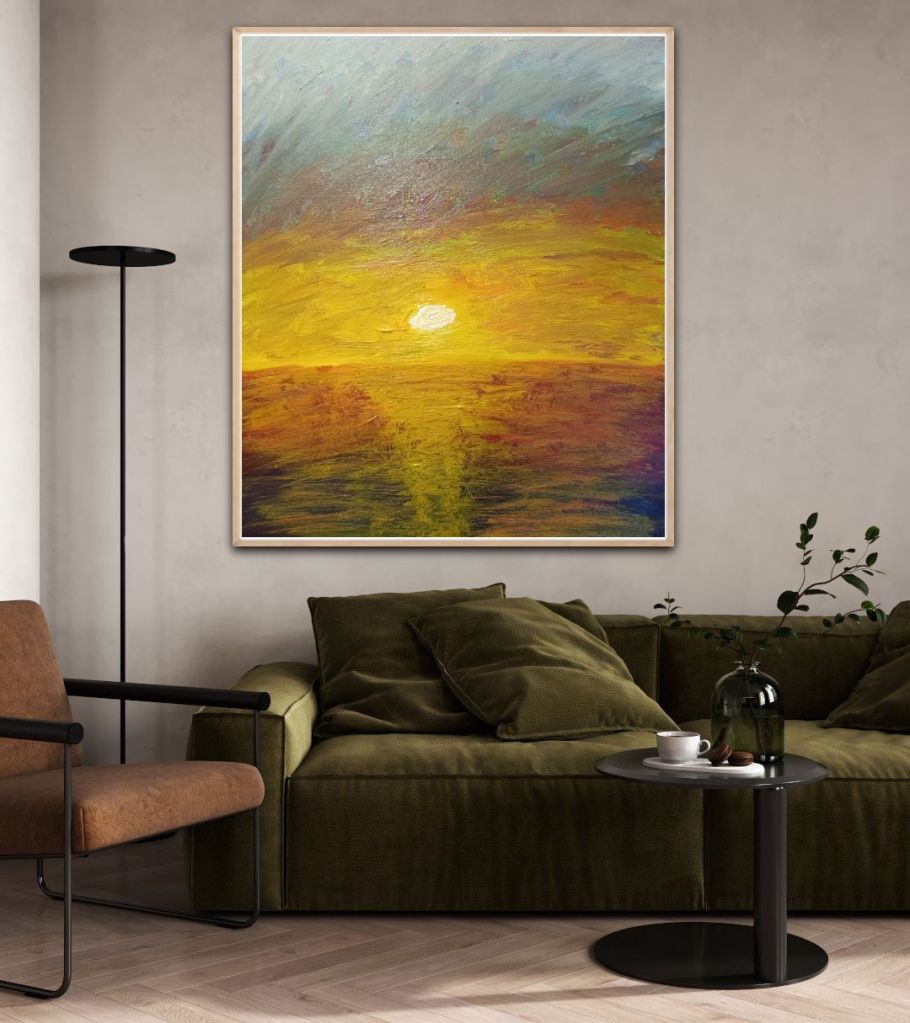
 Rain Bordo