
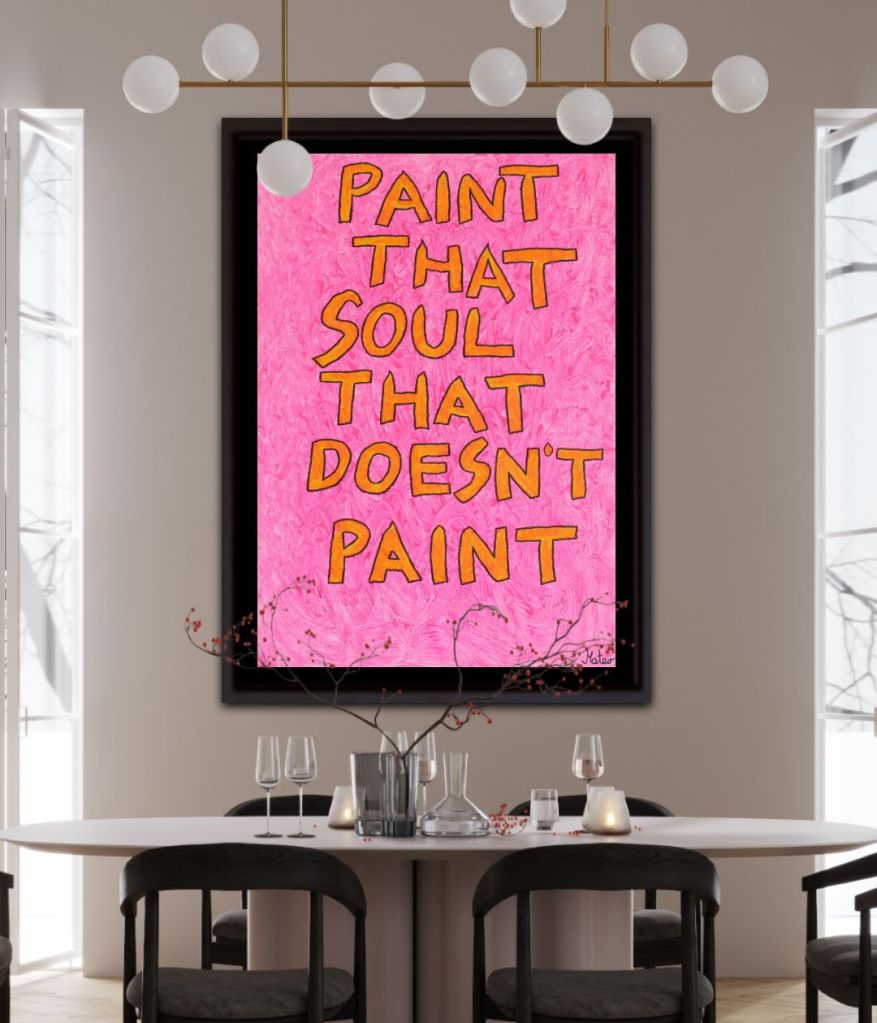
The painting Paint That Soul That Doesn’t Paint (2025) by Mateo Balaban, known as Rain Bordo, operates at the intersection of visual art, music culture, and existential provocation. Drawing a clear conceptual line to Metallica’s iconic slogan “Band that head that doesn’t bang”, Balaban translates the language of heavy metal rebellion into a painterly and philosophical register. What begins as a playful linguistic homage quickly becomes a serious inquiry into passivity, creation, and the moral responsibility of expression.
At first glance, the work is visually direct and unapologetic. A textured pink background—raw, uneven, almost bruised—hosts bold, hand-painted letters in a saturated yellow-orange tone outlined in black. The message is impossible to ignore: PAINT THAT SOUL THAT DOESN’T PAINT. There is no subtlety in its demand, and that is precisely the point. Like a Metallica riff, the painting doesn’t whisper—it commands.
The reference to Metallica is crucial. The original slogan “Band that head that doesn’t bang” is not merely about music or movement; it is about awakening. It suggests that if the body is inert, it must be shaken into life. Balaban extends this logic inward. For him, the danger is not a still body but a silent soul. Painting, in this context, becomes an act of revival. If a soul does not “paint”—does not create, feel, respond, or empathize—then it risks decay. Art, therefore, is not decorative; it is resuscitative.
The choice of color intensifies this reading. Pink, often associated with softness, vulnerability, or even superficial cheerfulness, is here rendered aggressively through thick, restless texture. It feels scratched, worked, almost wounded. This is not a comforting pink—it is exposed flesh. Against it, the yellow-orange letters vibrate with urgency, evoking warning signs, flames, or industrial hazard markings. The contrast suggests tension between fragility and force, between emotional openness and the violent necessity of awakening.
Balaban’s typography is intentionally imperfect. The letters are uneven, slightly awkward, visibly handmade. This refusal of polish aligns with the ethos of punk, metal, and anti-establishment art movements. Perfection would neutralize the message. Instead, the painting insists on human error, on the trace of the hand, on effort over elegance. Much like Metallica’s early raw sound, the power lies in authenticity rather than refinement.
Conceptually, Paint That Soul That Doesn’t Paint functions as both manifesto and accusation. It addresses not only artists but viewers, citizens, and human beings at large. In a world saturated with passive consumption—scrolling, watching, liking without feeling—the painting asks: what happens to a soul that no longer participates? Balaban seems to argue that neutrality is not innocent. A soul that does not paint is not empty; it is neglected.
Within the broader Rain Bordo philosophy, where empathy is a recurring central value, this work reads as a call to ethical creation. Painting here is not limited to canvas—it symbolizes any act of sincere engagement with the world. To “paint” is to care, to respond, to risk emotion. The painting suggests that those who have awakened have a responsibility toward those who haven’t. Just as loud music forces the head to move, honest art must disturb emotional inertia.
Ultimately, Paint That Soul That Doesn’t Paint is a battle cry disguised as a simple sentence. It borrows the energy of metal culture but redirects it toward introspection and moral urgency. Balaban doesn’t ask whether we like art; he asks whether we are alive enough to make it—or at least to feel it.
Like Metallica’s slogan, the message is blunt because the stakes are high. If the soul doesn’t paint, it doesn’t resonate. And if it doesn’t resonate, it slowly disappears. This painting stands as an act of resistance against that disappearance—a loud, pink, imperfect insistence that creation is not optional. 🎸🔥
 Rain Bordo