
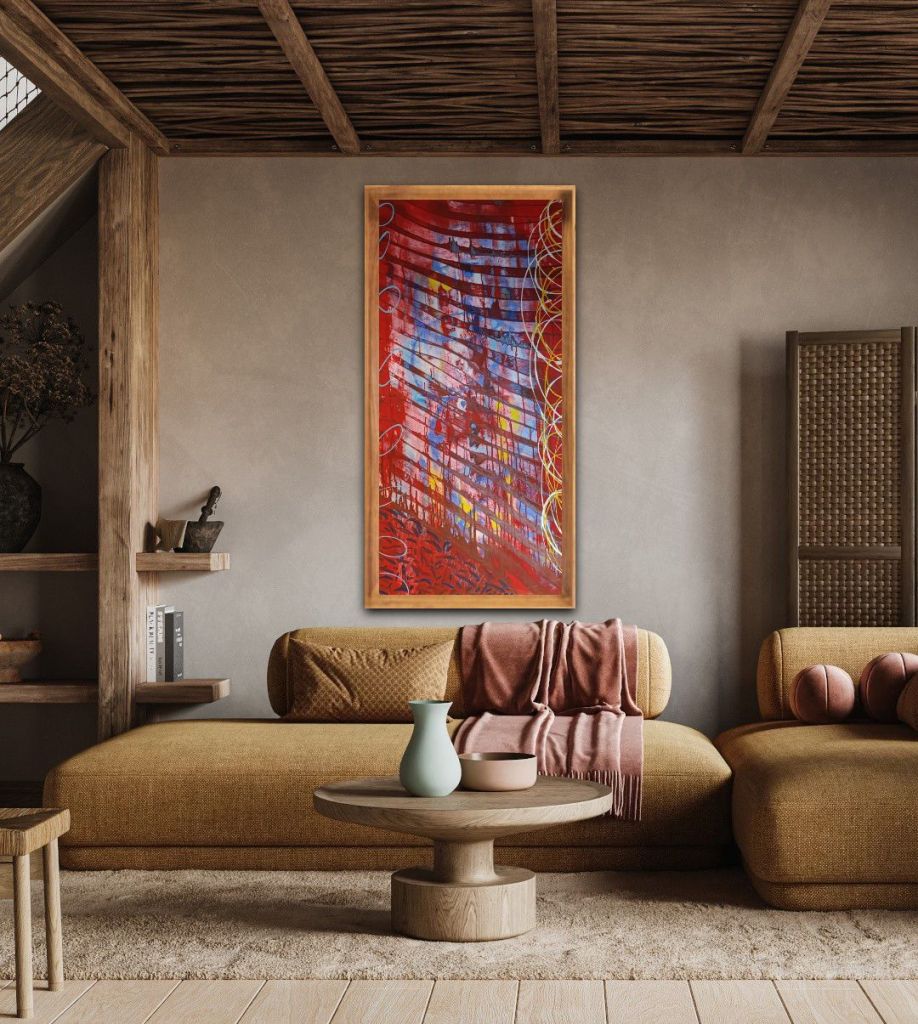
Rain Bordo’s untitled large-format canvas — currently displayed in situ against raw plaster and beneath a thatched wooden ceiling — belongs unequivocally to the second category. Framed in warm honey oak that barely contains its energy, this vertical explosion of red, blue, and gold feels less like something hung and more like something escaped.
The Surface
At first glance, the eye reads fire. A deep, almost arterial crimson floods the canvas from edge to edge, layered in what appears to be gestural passes of a wide brush or palette knife — horizontal striations that pulse like heat on asphalt. But look longer, and the red becomes something far more complex: a battleground, a memory, a frequency.
Beneath and within those crimson veins, a cooler world emerges — washes of powder blue and cerulean that feel geological, like sky glimpsed through a crumbling wall. They do not compete with the red. They survive it.
The Lines
What truly distinguishes this work from expressionist peers is Balaban’s deployment of line as liberated gesture. Looping, spiraling tendrils of white and gold dance across the upper right quadrant with a kind of reckless joy — calligraphic but untranslatable, like notes from a language that hasn’t been invented yet.
These lines are not accidents. They are the nervous system of the painting — the part that thinks, twitches, dreams. Where the red ground speaks in volume and weight, these lines speak in velocity and breath.
Meanwhile, darker, almost indigo marks creep from the lower regions of the canvas in organic, botanical clusters — as if the earth below is pushing upward, asserting its presence against the storm above. The tension between root and spiral, between gravity and flight, is where the painting finds its philosophical spine.
Scale and Space
Displayed in a warm, earthen domestic interior, the work commands an extraordinary spatial authority. The mustard yellow sofa, the terracotta throw, the pale ceramic vase on the table — all of them instinctively defer to it, as though the room had been quietly rearranged by the painting’s gravitational field.
This is intentional mastery. Balaban understands that color is not decoration — it is climate. He has painted a weather system and placed it indoors.
The Feeling
There’s a phrase critics reach for when language fails: “You feel it before you understand it.” With Rain Bordo’s work, you feel it, then you understand it, then you feel it again — differently. The painting shifts depending on your distance from it, your mood, the quality of the light.
Up close: chaos, texture, urgency.
At distance: harmony, landscape, breath.
This is not contradiction. This is the whole point.
Final Verdict
Mateo Balaban, working under the pseudonym Rain Bordo, delivers in this piece a work of exceptional emotional and compositional intelligence. It is loud without being aggressive, complex without being inaccessible, and deeply personal without being self-indulgent.
This is art that doesn’t ask for your attention.
It simply takes it.
“A painting that breathes. A room that listens.”
 Rain Bordo