
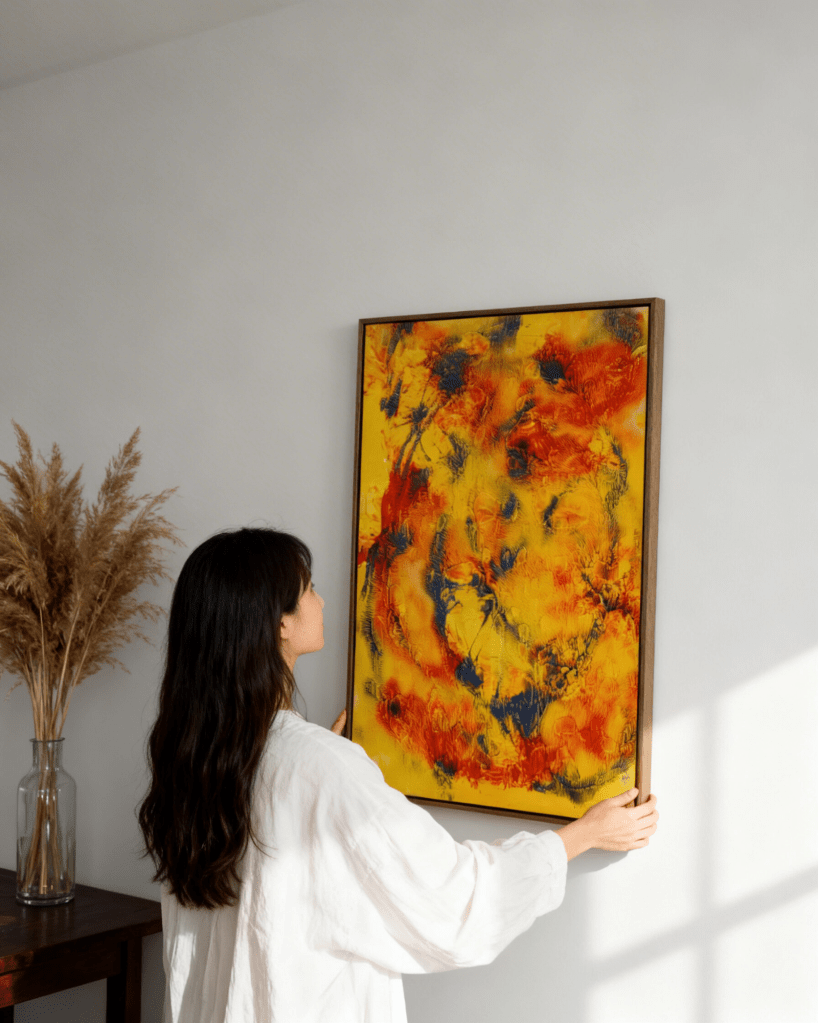
In his striking work, The Beginning of the Dilution of a Frozen Primrose, Mateo Balaban—professionally known as Rain Bordo—presents a visceral exploration of entropy and botanical transformation. The piece, showcased on his digital platform http://www.rainbordo.com, serves as a chaotic yet controlled meditation on the moment a static, frozen form yields to the fluid inevitability of thaw.
Artistic Synthesis and Technique
The composition is dominated by a high-octane palette of sun-drenched yellows and deep, bruised ambers, punctuated by veins of navy blue that suggest the receding grip of frost. Bordo’s technique leans heavily into Abstract Expressionism, where the “dilution” mentioned in the title is not just a subject, but a physical process visible in the layering of the pigment.
Texture: The surface appears topographical, almost as if the paint itself is undergoing a phase change.
Movement: There is a circular, centrifugal energy to the brushwork, mimicking the organic unraveling of a flower petal losing its structural integrity.
Parallels: Pollock’s Energy and Basquiat’s Rawness
To understand Bordo’s position in the contemporary abstract landscape, one must look at the giants whose ghosts haunt these canvases: Jackson Pollock and Jean-Michel Basquiat.
The Pollock Parallel: “The Action”
Like Pollock, Bordo treats the canvas as an arena for movement. We see echoes of Pollock’s “drip” philosophy in the way the colors bleed into one another. However, while Pollock sought a “pure” abstraction devoid of a focal point, Bordo retains a biological anchor. The “Primrose” serves as a ghost in the machine—a figurative origin point that gives the chaotic splatters a sense of purpose and gravity.
The Basquiat Parallel: “The Primal”
The connection to Basquiat lies in the unfiltered intentionality of the color choices. Basquiat used vibrant, often clashing hues to denote social and internal urgency. Bordo adopts this “street-art” ferocity but applies it to the natural world. There is a “Neo-Expressionist” grit in the dark, skeletal outlines buried beneath the yellow, reminiscent of Basquiat’s anatomical sketches, suggesting that beneath every beautiful flower lies a complex, messy infrastructure.
Final Verdict
The Beginning of the Dilution of a Frozen Primrose is a triumphant exercise in organic abstraction. Rain Bordo manages to capture a transition that is usually invisible to the naked eye—the literal melting of time. By bridging the gap between Pollock’s kinetic energy and Basquiat’s raw, emotive palette, Bordo carves out a space that is both historically grounded and Refreshingly modern.
Note: The scale of the work, as seen in the interior setting, emphasizes its role as a “statement piece” that demands the viewer’s full sensory engagement.
 Rain Bordo