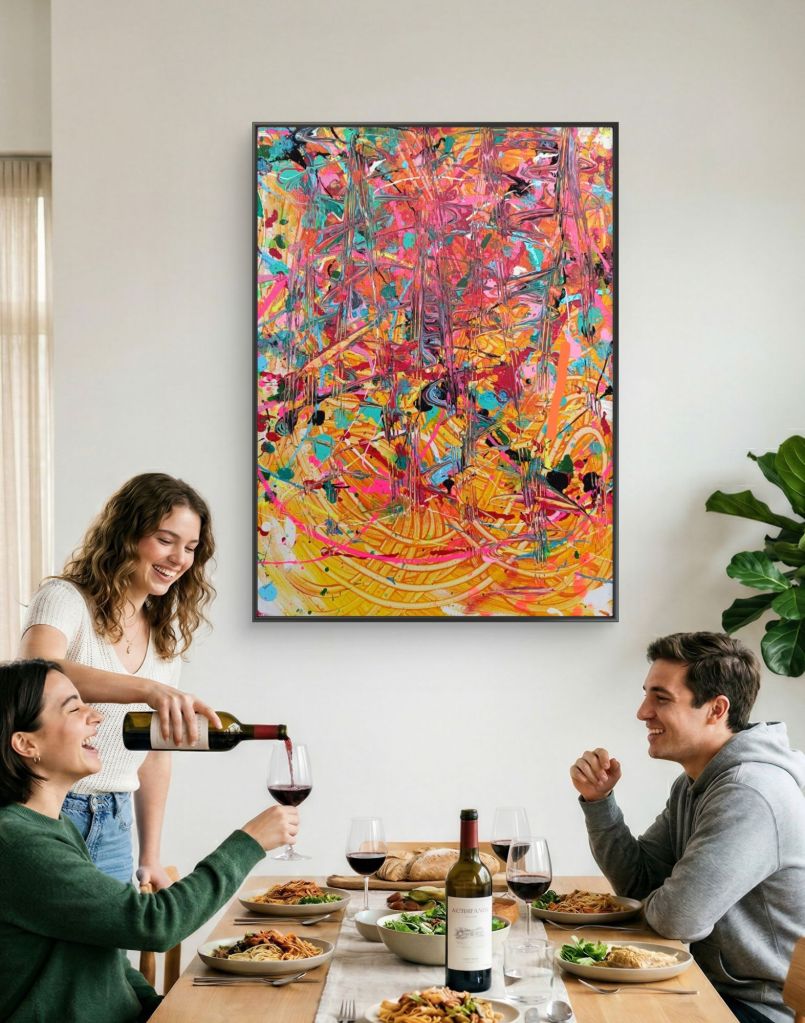
This painting by Mateo Balaban, known as Rain Bordo, does not ask for passive viewing—it demands emotional participation. It is not a scene; it is a state of being.
At first glance, the composition feels chaotic: aggressive strokes, splashes of saturated color, and vertical drips that seem to pull the eye both upward and downward at once. But the longer you stay with it, the less it feels like chaos and the more it reveals itself as a structured emotional language. There is rhythm here—almost like a pulse—hidden beneath the apparent disorder.
The dominant warm tones—yellows, reds, and oranges—suggest intensity, life, even overstimulation. They are interrupted by cooler blues and greens that act like breaths of air, small pauses in an otherwise overwhelming emotional landscape. This tension between warmth and coolness mirrors the human condition: the constant negotiation between inner chaos and the need for balance.
The vertical lines are especially striking. They resemble barriers, but also connections—like fragile bridges between fragmented thoughts or emotions. They drip, they collapse, they rebuild. It feels as though the painting is documenting a psychological process rather than presenting a finished idea. This is not a static image; it is movement frozen mid-struggle.
What makes this work powerful is its honesty. It does not try to beautify or simplify. Instead, it confronts the viewer with the raw complexity of feeling—confusion, energy, fragmentation, and the quiet persistence of structure within it all.
Placed in a domestic setting, as seen here, the contrast becomes even more meaningful. The calm, social moment beneath the painting—people sharing wine, laughing—exists in direct dialogue with the emotional storm above them. It suggests a subtle but profound idea: beneath every ordinary moment, there is an unseen depth. People carry entire inner worlds that rarely surface.
This is what the painting ultimately tells us: Human experience is layered, messy, and intense—but not meaningless. Even in chaos, there is structure. Even in fragmentation, there is connection.
 Rain Bordo