A Triptych Beginning with Innocence and Ending in Reckoning
Introduction: A Question That Should Not Exist
Why the Color Black Had to Die by Mateo Balaban (Rain Bordo) opens a triptych with a question that feels almost impossible to justify. It is a sentence that should never need to be asked—yet it exists, and because it exists, it exposes something deeply broken.
This first part does not attempt to explain. It confronts. It places the viewer in the position of a child—facing a world that has already made decisions the child cannot understand. And in that gap between innocence and reality, the painting finds its power.
The Scene: Creation as Impact
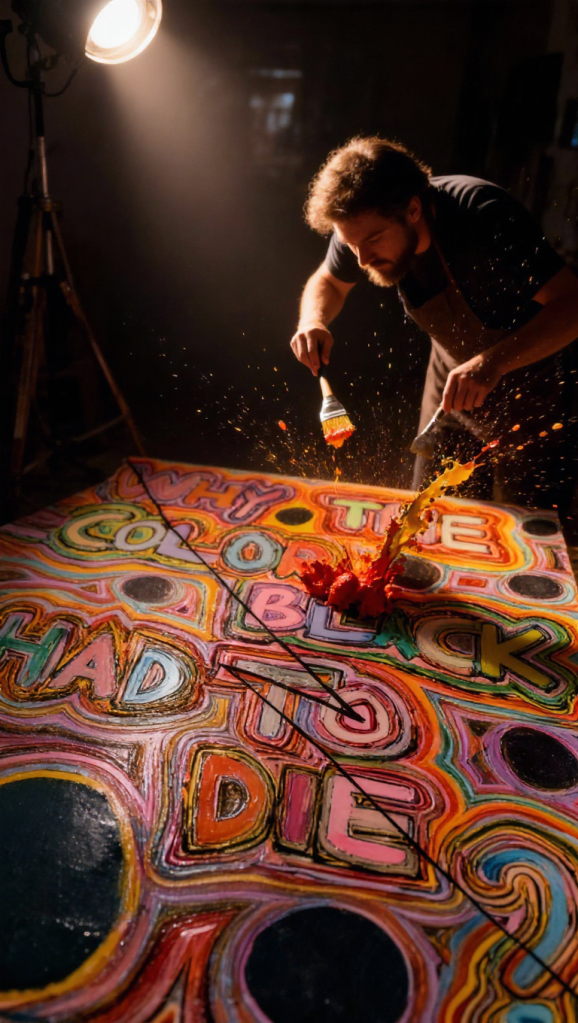
The image is not static—it is an event. The artist leans over the canvas, pouring paint with intensity, almost as if he is intervening in something already unfolding. Light isolates him, while the rest of the space fades into shadow, creating a theatrical contrast between action and consequence.
The paint does not gently settle. It explodes, splashes, collides. The moment captured feels irreversible. Something is being marked, altered, perhaps even erased.
This is not calm creation. This is confrontation.
Color as Conflict
The surface of the painting is loud—almost aggressively alive. Bright oranges, yellows, reds, and layered tones push against each other in restless motion. The energy is chaotic, uncontained, overwhelming.
And within that chaos, black appears differently.
It is not blended. It is isolated. Repeated in circular forms, it becomes something symbolic—void, presence, absence, identity, target. The question in the title suddenly gains weight: if black is here, visible, undeniable… why would it need to “die”?
The painting does not answer. It forces the viewer to sit with the absurdity of the premise.
The Language of Urgency
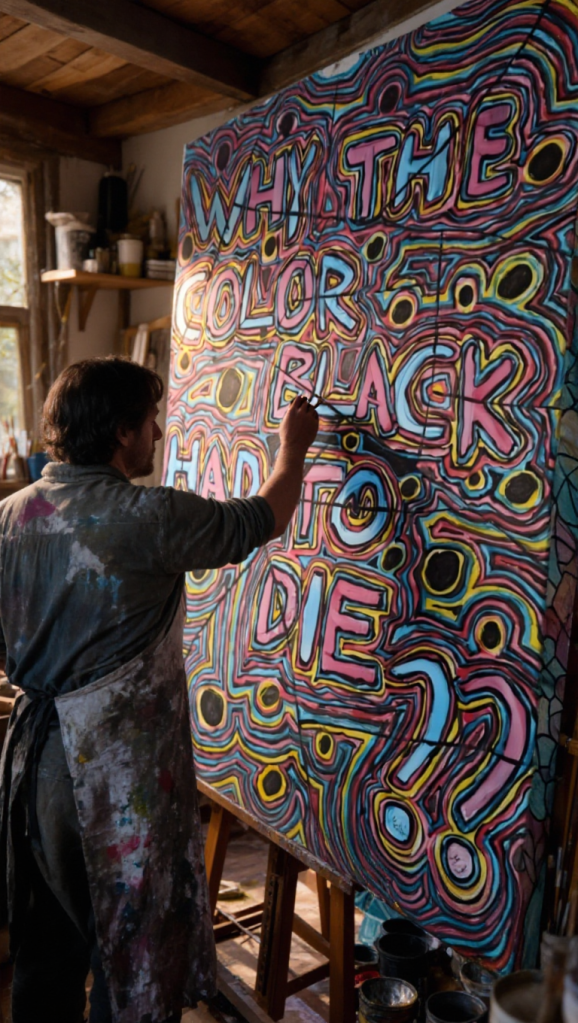
Words stretch across the canvas in a graffiti-like style—raw, immediate, unpolished. This choice is deliberate. Graffiti has always been a language of those pushed to the margins, a form of expression that does not wait for permission.
Here, language is not decorative—it is desperate. The letters feel like they are trying to hold something together, or perhaps trying to prevent something from being forgotten.
The message is fragmented, layered, almost overwhelming—mirroring the confusion of the child’s perspective.
The Child’s Perspective: Pure, Unfiltered, Dangerous
This first piece of the triptych represents the moment when a child asks a question without understanding the weight behind it.
A child does not carry ideology.
A child does not understand systems.
A child simply asks:
Why?
That “why” is the most honest and the most threatening force in this work.
Because it exposes the lack of logic behind racism. It strips it of justification. It reveals it as something learned, not inherent.
The painting captures the discomfort of that moment—the inability of the world to provide an answer that makes sense.
Transgenerational Racism: The Inheritance of Silence
At its core, the work speaks about transgenerational racism—not as a single act, but as a condition that passes quietly from one generation to the next.
No one moment creates it.
No one explanation resolves it.
It is absorbed—through language, behavior, fear, omission.
The child in this painting is standing at the edge of that inheritance. The question marks the beginning of awareness. It is the moment before understanding, before anger, before resistance.
But it is also the moment that makes everything else inevitable.
The Physical Act: Painting as Rupture
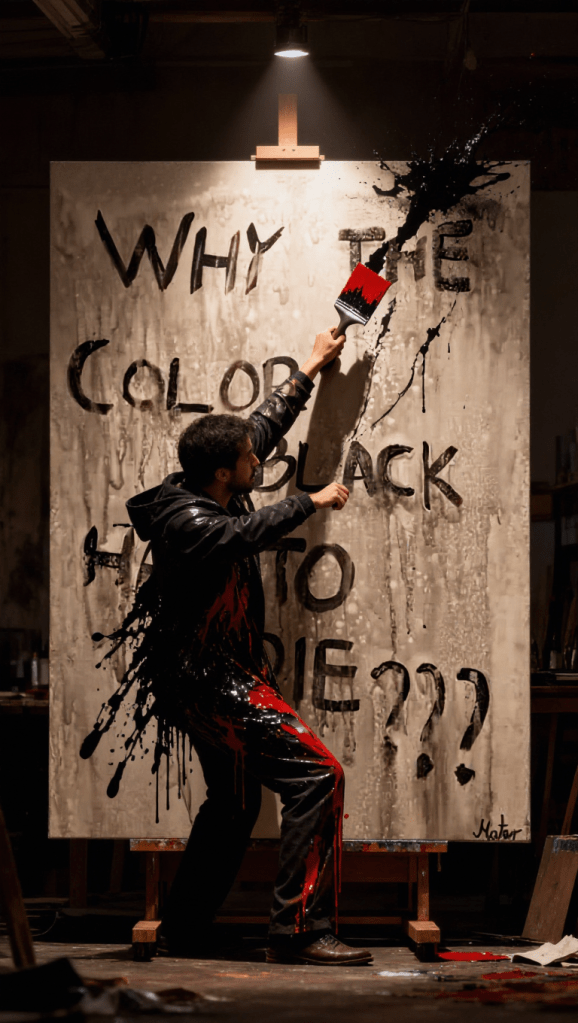
The act of pouring paint is central. It is not just technique—it is meaning.
The motion feels forceful, almost violent. The paint hits the surface like an interruption, like a break in continuity. It suggests that truth does not emerge quietly—it erupts.
In this sense, the artist is not just creating the work. He is disrupting something within it.
The painting becomes a site of tension between what has been inherited and what is being challenged.
The Beginning of a Transformation
As the first part of a triptych, this work is only the beginning. Its role is not resolution, but ignition.
The child asks
The teenager will question more deeply
The adult will demand answers
This progression is not just about age—it is about intensity. The emotional weight increases, the patience decreases, and the need for truth becomes unavoidable.
This first painting holds the quiet before that escalation—but even here, the tension is already visible.
Conclusion: A Question That Breaks the System
Why the Color Black Had to Die does not comfort the viewer. It does not guide them toward an easy conclusion. Instead, it leaves them in a state of discomfort—facing a question that should not exist, yet does.
And that is precisely its strength.
Because once the question is asked honestly, without filters, without inherited fear—it cannot be ignored.
It lingers.
It grows.
It demands to be carried forward.
Rasizam je loš. Evo malo opširnije i moje pjesme o rasizmu:
Radi se o nepravdi i rasizmu u američkom pravosudnom sustavu. Dylan priča priču o tome kako je Carter, talentirani crni bokser srednje kategorije (koji je bio blizu titule prvaka svijeta), nepravedno osuđen za trostruko ubojstvo u baru u Patersonu, New Jersey, 1966. godine.
Prema pjesmi (i stvarnim činjenicama koje je Dylan tada prihvaćao):
Policija i tužiteljstvo su ga optužili bez čvrstih dokaza, koristeći rasno profiliranje.
Svjedoci su bili prisiljeni ili potkupljeni da lažno svjedoče.
Sudski proces je bio pun manipulacija i rasizma — Carter je prikazan kao “revolucionarni bum” za bijelce, a za crnce kao “ludi n—–“.
Sve to dovelo je do toga da je nevin čovjek završio u zatvoru na doživotnu kaznu, umjesto da postane šampion.
Pjesma počinje dramatično:
“Pistol shots ring out in the barroom night / Enter Patty Valentine from the upper hall…”
i zatim u stilu filmske priče (Dylan je volio takav narativni stil) opisuje ubojstvo, uhićenje, suđenje i nepravdu.
Ključne poruke pjesme
Kritika rasizma i korumpiranog sustava koji je “trebao” krivca i brzo ga našao u crnom bokseru.
Carter je prikazan kao nevin čovjek kojeg su vlasti “došle okriviti za nešto što nikad nije učinio”.
Refren naglašava: “Here comes the story of the Hurricane / The man the authorities came to blame / For somethin’ that he never done…”
Pjesma je duga (preko 8 minuta), brza, ljuta i vrlo pripovjedna — gotovo kao mini-film u stihovima. Napisana je u suradnji s Jacquesom Levyjem.
Stvarni epilog
Carter je dvaput osuđen (1967. i 1976.), ali je 1985./1988. oslobođen nakon što je savezni sud poništio presudu zbog ozbiljnih proceduralnih grešaka i rasne pristranosti.
Dylanova pjesma i njegovi koncerti (uključujući Rolling Thunder Revue) pomogli su u podizanju svijesti o slučaju i prikupljanju novca za Carterovu obranu.
Tekst:
Pistol shots ring out in the barroom night
Enter Patty Valentine from the upper hall
She sees the bartender in a pool of blood
Cries out, “My God, they’ve killed them all”
Here comes the story of the Hurricane
The man the authorities came to blame
For somethin’ that he never done
Put in a prison cell, but one time he coulda been
The champion of the world
Three bodies lyin’ there does Patty see
And another man named Bello, movin’ around mysteriously
“I didn’t do it, ” he says, and he throws up his hands
“I was only robbin’ the register, I hope you understand”
“I saw them leavin’, ” he says, and he stops
“One of us had better call up the cops”
And so Patty calls the cops
And they arrive on the scene
With their red lights flashin’ in the hot New Jersey night
Meanwhile, far away in another part of town
Rubin Carter and a couple of friends are drivin’ around
Number one contender for the middleweight crown
Had no idea what kinda shit was about to go down
When a cop pulled him over to the side of the road
Just like the time before and the time before that
In Paterson that’s just the way things go
If you’re black, you might as well not show up on the street
‘Less you wanna draw the heat
Alfred Bello had a partner, and he had a rap for the cops
Him and Arthur Dexter Bradley were just out prowlin’ around
He said, “I saw two men runnin’ out, they looked like middleweights
Jumped into a white car with out-of-state plates”
And Miss Patty Valentine just nodded her head
Cop said, “Wait a minute, boys, this one’s not dead”
So they took him to the infirmary
And though this man could hardly see
They told him he could identify the guilty men
Four in the mornin’ and they haul Rubin in
They took him to the hospital and they brought him upstairs
The wounded man looks up through his one dyin’ eye
Say, “Why’d you bring him in here for? He ain’t the guy”
Here’s the story of the Hurricane
The man the authorities came to blame
For somethin’ that he never done
Put in a prison cell, but one time he coulda been
A champion of the world
Four months later, the ghettos are in flame
Rubin’s in South America fightin’ for his name
While Arthur Dexter Bradley’s still in the robbery game
And the cops are puttin’ the screws to him, lookin’ for somebody to blame
“Remember that murder that happened in a bar?
Remember you said you saw the getaway car?
You think you’d like to play ball with the law?
Think it might’ve been that fighter that you saw runnin’ that night?
Don’t forget that you are white”
Arthur Dexter Bradley said, “I’m really not sure”
The cops said, “A poor boy like you could use a break
We got you for the motel job, and we’re talkin’ to your friend Bello
You don’t wanna have to go back to jail, be a nice fellow
You’ll be doin’ society a favor
That son of a bitch is brave and gettin’ braver
We wanna put his ass in stir
We wanna pin this triple murder on him
He ain’t no Gentleman Jim”
Rubin could take a man out with just one punch
But he never did like to talk about it all that much
“It’s my work, ” he’d say, “I do it for pay
And when it’s over I’d just as soon go on my way”
Up to some paradise
Where the trout streams flow and the air is nice
And ride a horse along the trail
But then they took him to the jailhouse
Where they try to turn a man into a mouse
All of Rubin’s cards were marked in advance
The trial was a pig-circus, he never had a chance
The judge made Rubin’s witnesses drunkards from the slums
To the white folks who watched, he was a revolutionary bum
And to the black folks he was just a crazy nigger
No one doubted that he pulled the trigger
And though they could not produce the gun
The DA said he was the one who did the deed
And the all-white jury agreed
Rubin Carter was falsely tried
The crime was murder one, guess who testified?
Bello and Bradley, and they both baldly lied
The newspapers, they all went along for the ride
How can the life of such a man
Be in the palm of some fool’s hand?
To see him obviously framed
Couldn’t help but make me feel ashamed
To live in a land where justice is a game
Now all the criminals in their coats and their ties
Are free to drink martinis and watch the sun rise
While Rubin sits like Buddha in a ten-foot cell
An innocent man in a living hell
Yes, that’s the story of the Hurricane
But it won’t be over ’til they clear his name
And give him back the time he’s done
Put in a prison cell, but one time he coulda been
The champion of the world
……
POLJA OD PAMUKA (Mateo Balaban knjiga Autor kaosa)
Zemlja traži slugu, a ne gospodara.
Uz motiku plačem za vrijeme kopanja.
Nikako da se zvijezde poslože
pa da budem gospodar sudbine.
Zasjalo sunce na moj zatiljak,
curi znoj niz moj potiljak.
Zadnji atom snage dajem
možda i ne potrajem.
Ispod ovoga neba svi smo isti
ali kada dođe isplata, ti se zamisli
jer nekada ne dobiješ što si zaradio
nego čvrst stisak ruke i lijepi adio.
Nas sedmero patimo za jednoga
uobraženoga što tuče ženu.
Nije on kriv, ima mrenu
bačenu na nježnost i ljepotu.
Okupani znojem nastavljamo dalje,
da smo mornari bile bi iste ralje.
Koliko god kora imao ovaj kruh
nas sedmero ima bruh.
Oremo, kopamo, za život se borimo,
gladna usta neće se nahraniti ako sorimo
i svojim postupcima unakazimo
ono malo što nas ide, što zaslužujemo.
Nas sedmero ljudi koji su se okupili
na zemlji kako bi na njoj radili
u tu zemlju ćemo se i vratiti
uz znoj na suncu ćemo patiti.
Tvrd je bič našega gospodara
koji uz udarce progovara:
„Sad si moj rob, tromi čovječe
neka te udarac u leđa pokreće!“
Krvarimo nas sedmorica umornih,
vrijeme je sunčano, ali ima nas turobnih.
Svaki put kada padne gorka kiša, gospodar
je ljut i bičem na našim leđima ispiše memoar.
Tvrd je bič našega gospodara
koji uz udarce progovara:
„Sad si moj rob, tromi čovječe
neka te udarac u leđa pokreće!“
Sloboda je naša i mi ćemo je uzeti!
Znoj nad zemljom s nama će se boriti!
Mogu nam nanijeti smrt i bol,
ali dostojanstvo je naš odgovor!
Dostojanstvo je ključ i nema lokot.
Lanci oko duha i truli život;
nije naša sudbina smrtnost
mi smo rođeni za radost.
Mrzimo pakost.
Tvrd je bič našega gospodara
koji uz udarce progovara:
„Sad si moj rob, tromi čovječe
neka te udarac u leđa pokreće!“
Mi smo borci životne istine,
sve samo tihe nisu naše tišine.
Smrt pobjeđujemo dostojanstvom,
povijest ispisujemo blagoslovom.
Tvrd je bič našega gospodara
koji uz udarce progovara:
„Sad si moj rob, tromi čovječe
neka te udarac u leđa pokreće!“
Gospodar će večeras otići na dalek put,
nas sedmero je osakatio dok je bio ljut.
Lanci će mu presuditi jer je nanio bol
slobodnom čovjeku koji je bio gol.
Možda se nakon patnje nemamo čemu vratiti,
ali ova patnja dovoljan je razlog za uz nadu progledati!
Nas sedmero se imamo čemu radovati,
imamo jedni druge i nećemo ratovati.
Nećemo tugovati
Naš gospodar večeras se vraća u zemlju
odakle je i potekao.
Mi uzimamo svoju pobjedu
za svoje dostojanstvo se borimo!
U novi život pođimo
i zapjevajmo:
Sloboda!
Sloboda!
Sloboda!
……
ODGOVOR NA NJIHOVA POLJA OD PAMUKA
(Isto ja, Mateo Balaban poznat kao Rain Bordo, knjiga Cesta nema empatije)
Eksperimentiram religijama i volim zen,
vičem vjetru svoje nadnaravne emocije.
Krhotina sam pokušaja samosvijesti
da uokviri se u kutije normalnosti.
Nonšalantan sam i ne volim norme,
ne čekam kavu da zakuha jer nemam vremena.
Šerif sam na poljima pamuka, bičujem robove,
zaniječu mi ime pa dobiju dva puta po leđima.
Robovi me gledaju poprijeko očima,
čini mi se da nešto smjeraju.
Nekada sam ljut pa natučem ženu,
a nekada ne isplatim tuđe zarađeno.
Mogu što god poželim,
ja sam gospodar realnosti.
Moja riječ je apsolutna,
moji postupci veličaju život.
Večeras sam odšetao pogledati bikove u staji.
Nešto je zatreslo u kutu. Bili su to robovi.
Imali su lance u rukama. Jedan me udario.
Pao sam na zemlju, krv je počela teći.
Večeras udarci upućeni meni, a nisam kriv.
Nekada sam ljut pa natučem ženu,
a nekada ne isplatim tuđe zarađeno.
Nekada bičujem ljude, ali nisam kriv.
Mogu što god poželim,
ja sam gospodar realnosti.
Moja riječ je apsolutna,
moji postupci veličaju život.
Nekada bičem izbacujem ljutnju.
Nekada pljujem robovima u lice.
Nekada natučen ženu, a nisam kriv.
Ručak uistinu nije valjao.
Mogu što god poželim,
ja sam gospodar realnosti.
Moja riječ je apsolutna,
moji postupci veličaju život.
Večeras nestajem, a nisam kriv.
Večeras odlazim, a nisam kriv.
Večeras ne pjevam, a nisam kriv.
Večeras je moj kraj, a nisam kriv.
Mogu što god poželim,
ja sam gospodar realnosti.
Moja riječ je apsolutna,
moji postupci veličaju život.
Ne razumijem u čemu je problem?!
Mogu što god poželim,
ja sam gospodar realnosti!
Moja riječ je apsolutna,
moji postupci veličaju život!
…..
KĆER PAMUKA (Mateo Balaban, knjiga Krhotine nekadašnjeg carstva)
Za moj peti rođendan tata
mi je kupio crnog prijatelja.
Ne razumijem zašto toliko
plače taj moj prijatelj…
Prijatelj plače kada je nasamo
sa mnom. Volim ga.
Igramo se ispijanja čaja s
mojim lutkicama. Precool!
Baš nam je lijepo.
Često mu je košulja crvena na leđima.
Izgleda kao da je natopljena.
Ne znam.
Tata kaže da se umočio u
crvenu boju dok je farbao zid.
Moj crni prijatelj kaže da jako voli glazbu.
Pa i ja volim glazbu, predobro!
Kaže da voli svirati glasovir pa sam
nagovorila tatu da svira
na mome šestom rođendanu.
Super!
Prijatelj je bio sretan što će imati priliku svirati…
Na rođendan sam pozvala sve tatine crne prijatelje i sve crne prijateljice.
Koji moćni i sretni ljudi!
Jedino ne znam zašto su imali suze
u očima dok su plesali uz glasovir.
Možda su sretni…
Moj crni prijatelj kaže da voli
gledati zalazak sunca.
Pa to i ja volim!
Imamo toliko toga zajedničkog!
Pitala sam tatu da idemo u lunapark
moj crni prijatelj i ja i moja mama, ali i tata.
Kaže tata da se smradovi ne smiju zabavljati.
O čemu on priča?
Pa normalno miriše.
Ne kužim.
Sinoć je Simon imao košulju baš jako
natopljenu crvenom bojom.
Tata kaže da je ofarbao puno kvadrata jer je dovoljno hrabar da kaže što ga muči.
Samo; ne znam gdje farba zidove kada je kod nas sve bijele boje.
Čisto.
Možda kod susjeda. Ne znam.
Imao je i obraze crvene i ruke.
I hlače.
Ne znam.
Pitala sam ga da se igramo ispijanja čaja
kako to obično i radimo,
ali me kroz suze pitao smije li ići spavati
jer je umoran, a i ruke su mu drhtale.
Ne znam.
Čudno.
 Rain Bordo